
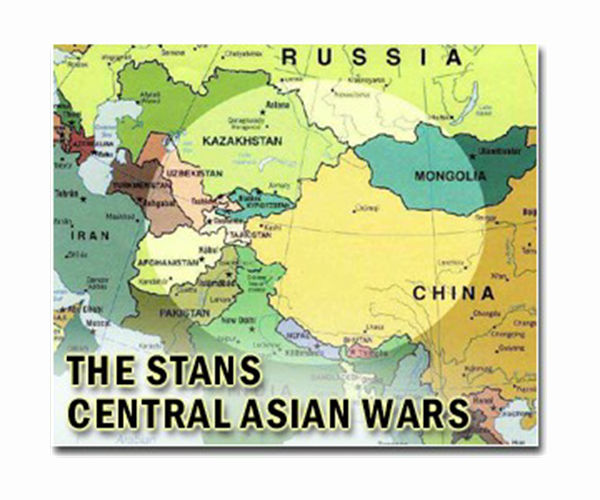
A Russia-led security bloc said Thursday that it planned to hold large military drills in Tajikistan next month amid what it described as a deteriorating situation in neighbouring Afghanistan.
Moscow has moved to cement its position as a key player in the region after the United States' hasty retreat from Afghanistan and the Taliban's takeover of the country.
The general secretary of the Moscow-led Collective Security Treaty Organisation (CSTO) Stanislav Zas said the group would hold several "large scale exercises" in the ex-Soviet state.
Tajikistan is the only country out of the six-member bloc led by Russia that shares a border with Afghanistan.
The series of drills will include "our largest exercise this year," Zas said.
The group has taken "collective measures" to ensure Tajikistan's security in case of an "aggravation" on its border with Afghanistan, he added.
The CSTO said in a joint statement that it was alarmed by the deterioration of security in Afghanistan.
Zas announced the drills after Russian Foreign Minister Sergei Lavrov put the Taliban on notice Wednesday, noting that Moscow was monitoring the group's fulfilment of promises to prevent radical groups from launching attacks on Afghanistan's neighbours.
Countries allied with Russia and China are holding a series of meetings in Tajikistan this week, centering around crisis-hit Afghanistan.
Russia has ramped up military drills in Central Asia in recent months since the Taliban began a series of lightning offensives that culminated with the hardliners capturing Kabul last month.
In addition to drills in CSTO members Kyrgyzstan and Tajikistan, Moscow has conducted joint exercises with Uzbekistan, a former member of the bloc that shares a 144-kilometre border with Afghanistan.
Security blocs led by Russia, China meet on Afghanistan
Dushanbe, Tajikistan (AFP) Sept 15, 2021 –
Countries allied with Russia and China were preparing for a series of meetings on Afghanistan Wednesday held in the crisis-hit country's neighbour, Tajikistan.
Moscow and Beijing have moved to assert themselves as key players in the region, after the United States' hasty retreat from Afghanistan and the Taliban's takeover of the country.
Two regional security blocs led by Moscow and Beijing are holding summits in the capital of ex-Soviet Tajikistan, Dushanbe, this week along with other countries attending as observers and guests.
Afghanistan, already heavily dependent on aid, is facing a new economic crisis in the aftermath of the Taliban's takeover, with the new authorities unable to pay salaries as food prices soar.
Its neighbours are wary of the threat of a sustained refugee crisis, as well as of spillover violence if the Taliban fail to control extremist groups with whom they were allied in the past.
At a pre-summit meeting on Wednesday, the general secretary of the Moscow-led Collective Security Treaty Organisation(CSTO), Stanislav Zas, called for more humanitarian aid to Afghanistan.
The eight-member Shanghai Cooperation Organisation (SCO), headed by China, is also due to meet in Dushanbe this week, with some countries belonging to both blocs.
The CSTO and the SCO have in the past been viewed as Moscow's and Beijing's counters to Western geopolitical dominance.
But the withdrawal of NATO, their rival, from Afghanistan has offered the biggest test yet for their regional clout.
Dual summit host Tajikistan has in recent weeks raised alarm over the presence of militant groups along its mountainous border with Afghanistan.
It has also criticised international institutions for not doing enough to help authorities accommodate refugees.
Zas acknowledged that the situation on Tajik-Afghan border was "unfavourable" Wednesday and pledged that Dushanbe would be provided with "all the necessary military and military-technical assistance" to combat any threat from the south.
Russian foreign minister Sergei Lavrov and defence minister Sergei Shoigu were to hold talks with Tajikistan's strongman Emomali Rakhmon on Wednesday, Russian news agency RIA Novosti reported.
– New regional security picture –
Founded in 2001, the SCO consisted of China, Russia, Kyrgyzstan, Kazakhstan, Tajikistan and Uzbekistan before India and Pakistan joined the group in 2017.
Iran, whose president Ebrahim Raisi is expected in Dushanbe Friday, is also keen to join.
Russia's Vladimir Putin, China's Xi Jinping and India's Narendra Modi are all attending the SCO summit virtually.
Afghanistan holds observer status at the SCO, but Russia's Lavrov said Wednesday that the Taliban had not been invited to observe proceedings in Dushanbe.
"Nobody is hurrying to give full recognition to the Taliban," Lavrov said.
Moscow has been cautiously optimistic about the new leadership in Kabul, and has slammed US policy in Afghanistan.
Lavrov said he "welcomed" several Taliban promises, including on curbing drug-trafficking and preventing attacks on other countries.
"Now we are monitoring to see how it will be fulfilled in practice," Russia's top diplomat said.
