
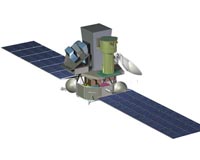
Russia could launch the Spektr-RG (Spectrum Roentgen Gamma) space observatory with the German eRosita X-ray telescope in October 2018, a spokesperson of the Lavochkin Research and Production Association aerospace company told Sputnik on Monday.
The Spektr-RG observatory is supposed to be placed at Lagrange point L2, an orbital location where gravitational forces of the Moon and Earth would balance out a centrifugal force of a smaller third body, such as a space observatory, stabilizing it.
It is expected to stay at L2 for seven years; it will survey the whole sky for four years and monitor the most interesting targets to be found during its mission over the remaining three years.
Initially, Russia planned to launch the observatory in 2014, but the launch date has been repeatedly postponed.
"The launch is slated for October 2018," the spokesperson of the company responsible for assembling of the space observatory said.
The spokesperson added that the preparations were being carried out on schedule.
Chandra Peers Into a Nurturing Cloud
In the context of space, the term 'cloud' can mean something rather different from the fluffy white collections of water in the sky or a way to store data or process information. Giant molecular clouds are vast cosmic objects, composed primarily of hydrogen molecules and helium atoms, where new stars and planets are born. These clouds can contain more mass than a million Suns, and stretch across … read more
