
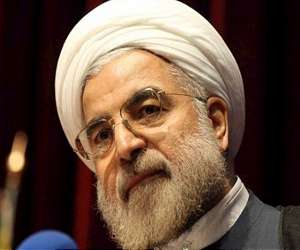
President-elect Hassan Rowhani Saturday hailed his victory as one of moderation over extremism, urging world powers to treat Iran with respect and acknowledge its rights in order to receive an appropriate response.
"This is a victory of intelligence, of moderation, of progress… over extremism," Rowhani said in televised remarks.
"A new opportunity has been created by this great epic, and the nations who tout democracy and open dialogue should speak to the Iranian people with respect and recognise the rights of the Islamic republic," he said.
Then they will "hear an appropriate response," he added.
Rowhani was in charge of Tehran's nuclear negotiations from 2003 to 2005.
He was alluding to the country's insistence that it has a right to its nuclear energy programme, which it insists is peaceful despite Western claims it hides an arms programme.
Khamenei, not president, calls Iran nuclear shots: Israel
Jerusalem (AFP) June 15, 2013 –
Israel reacted to the election of Iran's new president on Saturday by saying it was supreme leader Ayatollah Ali Khamenei who decides on nuclear policy, not the president.
"Iran's nuclear programme has so far been determined by Khamenei, and not by Iran's president," the foreign ministry said after Hassan Rowhani was elected to succeed Mahmoud Ahmadinejad.
"After the election, Iran will continue to be judged by its acts, in the nuclear field as well as that of terrorism," the statement said.
"Iran must conform to the demands of the international community and stop its nuclear programme and cease spreading terrorism in the world."
Rowhani was seen as a moderate candidate, but Israel's foreign ministry questioned the moderation attributed to Iran's president-elect.
"The president of Iran was chosen by Ayatollah Khamenei, who disqualified and prevented the candidates who did not conform to his extremist views from standing," the statement added.
But a senior Israeli official speaking on condition of anonymity said the election showed the Iranian people's desire for change.
"The Iranian people have showed their leaders that they oppose the path that has lead to sanctions and made their lives more difficult," he said.
"If Iran does not respect the demands of the international community and immediately cease its nuclear programme, the international community must increase the pressure on Iran," he added.
This echoed the statements of Israeli Defence Minister Moshe Yaalon who had said before the results of the Iranian election that he favoured tougher sanctions against the Islamic republic regardless of the results at the polls.
"We must toughen the sanctions against Iran and make this country understand that the military option remains on the table to halt the progress of its dangerous nuclear programme," a radio station quoted Yaalon as saying on a visit to the United States.
Israeli Prime Minister Benjamin Netanyahu said on Wednesday that Iran's presidential election would bring about no significant change in Tehran's policies.
He said the Tehran "regime will continue to be led by one man, one ruler (who) will continue Iran's quest for nuclear weapons."
Israel, the region's sole if undeclared nuclear power, along with the West accuses Iran of using its atomic energy programme as a cover for developing an atomic bomb. Tehran roundly denies those claims.
Tehran is also accused of aiding the Lebanese Shiite movement Hezbollah and the Palestinian movement Hamas, both bitter enemies of the Jewish state.
