
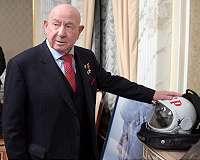
In an interview with Latvia's Radio Baltkom, retired Russian cosmonaut Alexey Leonov, who became the first human to make a spacewalk, gave his thoughts on how he felt when going into outer space.
Speaking to Latvia's Radio Baltkom, retired Soviet-era Russian cosmonaut Alexey Leonov admitted that he did not know what he would face in outer space when he became the first human being to perform a spacewalk, and that none of his relatives knew about the event beforehand.
On March 18, 1965, Leonov became the first human to venture outside a spacecraft, exiting the capsule during the Voskhod 2 mission for a 12-minute spacewalk.
"It was a road to nowhere. I knew nothing about it and no one in the world knew what I would meet there and what would happen to me," Leonov said, referring to his first spacewalk.
He added that he was curious rather than scary because he said "fear paralyses a person and if I yielded to panic I would never have carried out the spacewalk."
Leonov, who turns 83 on May 30, told Radio Baltkom that it took him more than two years to prepare for the March 18, 1965 event.
"I had been preparing for the spacewalk in accordance with a special program for 30 months. My relatives did not even know that I would go into outer space; they only knew that I would make a flight on board a spaceship," Leonov said.
He recalled that at the time, all the cosmonauts were required to work in outer space, and that special attention was attached to the cosmonauts' physical and moral training.
Interestingly, he described humans as "very convenient creatures" who will continue to improve themselves in the future.
"Even in the distant future, people will look like us; I believe that they will be beautiful, slender, kind, intelligent and that they will certainly conquer space," Leonov said.
Orion Motor Ready for Crewed Mission
Engineers at Orbital ATK's facility in Elkton, Maryland, recently completed a successful test of the Orion Launch Abort System motor designed to steer the astronauts away to safety in the unlikely event of an emergency.
The Launch Abort System includes three motors, and the motor tested was the attitude control motor.
This motor consists of a solid propellant gas generator, with eigh … read more
