
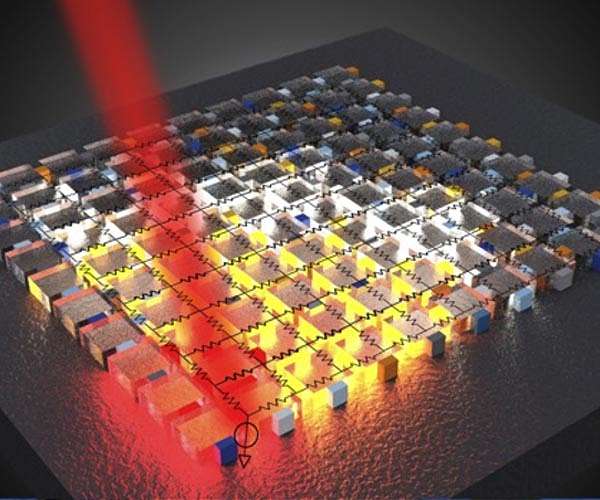
Analog photonic solutions offer unique opportunities to address complex computational tasks with unprecedented performance in terms of energy dissipation and speeds, overcoming current limitations of modern computing architectures based on electron flows and digital approaches.
In a new study published in the journal Nature Communications Physics, researchers led by Volker Sorger, an associate professor of electrical and computer engineering at the George Washington University, reveal a new nanophotonic analog processor capable of solving partial differential equations. This nanophotonic processor can be integrated at chip-scale, processing arbitrary inputs at the speed of light.
