
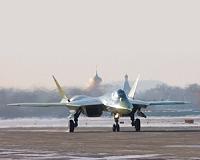
Russian media reported the Russian military is equipping Sukhoi Su-34 fighter-bombers with air-to-air missiles for combat missions in Syria.
The multi-role warplanes will be equipped with both short and medium-range air-to-air missiles capable of hitting targets within a 37-mile range, marking the first time the planes will carry such weaponry in the Russian anti-terror campaign in Syria.
Russia Today reports Russian defense officials maintain the missiles will be used for defensive purposes as they continue their fight against the Islamic State, Sunni radicals based in Iraq in Syria also identified as Daesh and by the acronyms ISIS and ISIL.
"The Russian Su-34 fighter-bombers today have for the first time taken on combat mission not only the OFAB-500 air bombs and KAB-500 guided bombs, but also short-and medium-range air-to-air missiles. The planes are equipped with missiles for their defence," Russian Aerospace Forces Colonel Igor Klimov told Russian state-owned news agency TASS.
The Sukhoi-made Su-34 multi-role fighters are based on the earlier designed Su-27s, fourth-generation fighters designed for tactical engagement against both ground and naval targets.
The new equipment on the planes follows escalating tensions between Russia and NATO-member Turkey, a country also engaged against the Islamic State, after Turkish F-16s shot down a Russian fighter jet that entered Turkish air space.
'Around 100' US special ops forces to deploy to Iraq to combat IS
Washington (AFP) Dec 2, 2015 –
The United States is sending about 100 commandos to Iraq to fight Islamic State jihadists in that country and across the border in Syria, a US military spokesman said Wednesday.
"Probably around 100, maybe a little bit less," Colonel Steve Warren said. "In fact, really fewer actual trigger-pullers, if you will … It's a very small number, a double-digit number."
Warren's comments came the day after Defense Secretary Ashton Carter announced additional special forces troops would join the fight against the IS group, though the Pentagon chief did not give details on the size of the deployment.
Iraqi Prime Minister Haider al-Abadi reacted to Carter's announcement by saying Iraq does not need foreign ground troops to defeat the IS group, but he did not directly reject the deployment and US officials downplayed his remarks.
"We've been talking with the prime minister about this for weeks," Warren said.
The specially trained commandos will be involved in direct combat against IS jihadists, but the Pentagon insists their mission doesn't contradict a White House pledge to avoid US "boots on the ground" and did not constitute "mission creep" in which the United States gets incrementally bogged down in a ground war against the IS group.
This is not "ground combat with armor and artillery and combined armed operations and death and destruction everywhere you look," Warren said.
"These are raids, these are a small number of highly skilled commandos conducting very precise, very limited operations … so there is a difference."
The United States already has about 3,500 troops in Iraq, but their mission is to "train and advise" local forces.
