
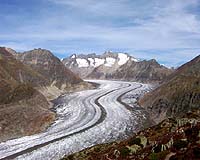
Europe's longest glacier shrank by 66 metres (72 yards) last year because of global warming, Swiss scientists said Wednesday.
The 23-kilometre (14-mile) Aletsch glacier in Switzerland's southern Alps was the second worst-affected in a study by experts from the Swiss Academy of Sciences.
Overall, 84 of the 91 glaciers in the academy's study shrank last year.
The findings are in line with those in previous years, said Professor Andreas Bauder, one of the experts who produced the report.
Hardest-hit was the Trift glacier, which lost 216 metres (708 feet) over the year.
However, noted Bauder, that was largely because it is surrounded by a lake.
Because it is getting smaller it is gradually emerging from the waters — and that means it is likely to shrink at a slower pace, Bauder told AFP.
The Trift is around five kilometres (three miles long).
Forecasting the future of Switzerland's glaciers is difficult, he added.
While shrinkage caused by global warming is relatively easy to predict, snow and rainfall also play a vital role and they are harder to gauge.
The academy also analysed the impact of global warming on three mountain ice caps in the Alps: the Basodino, Gries and Silvretta.
They shrank by between 70 centimetres (27 inches) and 1.7 metres (66 inches) last year, the study found.
Switzerland is home to more than 1,800 glaciers.
According to a 2004 study by the University of Zurich, they have shrunk by around a fifth in the past 15 years.
Source: Agence France-Presse
