
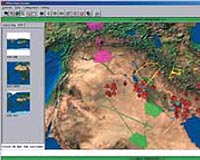
Raytheon demonstrated the potential to employ a U.K. adaptation of the US-deployed Distributed Common Ground System (DCGS) to provide a more accurate, timely understanding of an adversary and their actions.
The demonstration took place during the 2008 Coalition Warrior Interoperability Demonstration June 2-20 in Portsmouth, U.K.
The Raytheon team used key technologies, including DCGS and the DCGS Integration Backbone (DIB), to integrate existing applications, data bases and shared services from diverse intelligence suppliers and users providing UK forces with network-enabled solutions.
This capability will give the U.K. military the ability to discover and catalogue information from otherwise disconnected systems or "hubs" of intelligence information.
Additionally, Raytheon demonstrated DCGS software tools that let users organize, exploit and disseminate intelligence information in a way reminiscent of Internet operations.
The result will be a U.K. virtual knowledge base that provides commanders and warfighters with a more complete instantaneous picture of the enemy's activities.
"The success of this demonstration is a significant achievement for Raytheon Systems Limited and our partner, the U.K. Ministry of Defence," said Brian McKeon, chief executive, Raytheon Systems Limited. "We have leveraged a major U.S. investment in DCGS tools to provide significant new net-enabled intelligence capability by rapidly integrating existing U.K. sources of information and applications."
"The Coalition Warrior Interoperability Demonstration exercise dramatically demonstrates the U.K. government's ability to integrate a DCGS-like system that is uniquely for the uses of the U.K. Ministry of Defence," said Michael D. Keebaugh, president of Raytheon's Intelligence and Information Systems business.
The DIB uses open, international standards and capabilities commonly found outside the military community, such as in banking or transportation. The DIB provides core services and portals capabilities that allow the community of previously isolated users and systems to work together seamlessly regardless of location.
Raytheon created the DIB for U.S. forces who have invested considerable time and money to make it operationally ready. In the U.S., Raytheon is under contract for the next evolution of the DIB, called DIB 1.3.
