
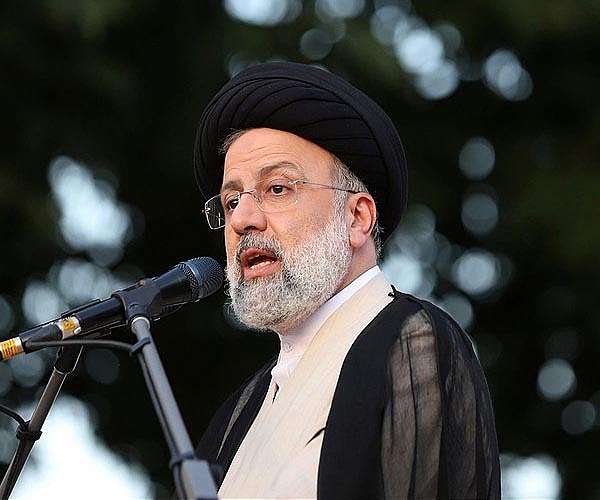
Israel's new premier Naftali Bennett Sunday described the victory of ultraconservative Ebrahim Raisi in Iran's presidential election as a "wake up" call for parties to a nuclear deal with Tehran.
Raisi was elected with just under 62 percent of votes cast in Friday's poll, and will replace moderate President Hassan Rouhani — whose landmark achievement was a 2015 nuclear deal between Iran and world powers — in August.
"Raisi's election is, I would say, the last chance for the world powers to wake up before returning to the nuclear agreement, and to understand who they are doing business with," said Bennett, in remarks at a cabinet meeting on Sunday.
The 2015 deal saw Iran accept limits on its nuclear capabilities in return for an easing of sanctions, but former US president Donald Trump unilaterally withdrew three years later and ramped up sanctions, prompting Tehran to pull back from its nuclear commitments.
Trump's successor Joe Biden has signalled his readiness to return to the deal and state parties — also including China, Russia, Britain, France and Germany — have lately been negotiating its revival in Vienna.
Israel and Iran are arch enemies and the Jewish state has always opposed the nuclear agreement, which it says could enable the Islamic republic to develop nuclear arms.
A change of Israeli government a week ago — which saw long-serving prime minister Benjamin Netanyahu ousted from office — has not changed the country's policy on this matter.
In an initial reaction to Raisi's election win, Israel's foreign ministry said late Saturday that the international community should be alarmed because of his commitment to a "rapidly advancing military nuclear program".
It also described Raisi as Iran's "most extremist president to date".
Iran has always denied seeking a nuclear weapon.
Jewish nationalist Bennett came to power last Sunday after Israel's parliament approved a disparate coalition that gives him the premiership until 2023, when his main partner in the new alliance — centrist Yair Lapid — is due to take over.
Lapid, who became foreign minister as part of the coalition agreement, earlier this week pledged Israel "will do whatever it takes to prevent Iran obtaining a nuclear bomb" and said he was opposed to a revival of the 2015 deal.
Iran's supreme leader still arbiter of nuclear deal: US advisor
Washington (AFP) June 20, 2021 –
The US national security advisor said Sunday that even with the election of an ultra-right president in Iran, the "ultimate decision" on recommitting to the 2015 nuclear deal lies with that country's supreme leader.
"Whether the president is Person A or Person B is less relevant than whether their system is prepared to make commitments to restrain their nuclear program," Jake Sullivan said on ABC's "This Week."
His comments followed the election Friday in Iran of ultraconservative cleric Ebrahim Raisi as president, succeeding moderate Hassan Rouhani — for whom the nuclear deal was a landmark achievement — and they come as talks in Vienna on rescuing the nuclear deal stand at a potential turning point.
"The ultimate decision for whether or not to go back into the deal," Sullivan said, "lies with Iran's supreme leader."
The 81-year-old Ayatollah Ali Khamenei has long stood as the ultimate arbiter of Iran's strategic posture. Raisi is considered a close Khamenei loyalist.
Under former president Donald Trump, the United States quit the Iran nuclear deal in 2018 and imposed new sanctions on Tehran.
His successor Joe Biden has said he wants to return to the accord as a crucial way of reining in Iran's nuclear program.
The multination talks in Vienna, underway since April, aim to bring the US back into the deal and to persuade Tehran to again abide by curbs on its nuclear program while providing Iran with sanctions relief.
Israel, a close US ally and bitter foe of Iran, has been fiercely critical of the nuclear deal.
Israel's new premier Naftali Bennett Sunday described Raisi's victory as "the last chance for the world powers to wake up before returning to the nuclear agreement."
But Enrique Mora, top European Union diplomat at the Vienna talks, said Sunday that negotiators were "closer" to saving the deal, despite some sticking points.
Sullivan also expressed cautious optimism.
"There is still a fair distance to travel on key issues, including sanctions and commitments Iran has to make," he said.
But, Sullivan added, "The arrow has been pointed in the right direction… We'll see if Iranian leaders are prepared to make the hard choices."
Iran nuclear deal negotiators take stock
Vienna (AFP) June 20, 2021 –
Negotiators trying to save the Iran nuclear deal will meet on Sunday, after an ultraconservative cleric won presidential elections in the Islamic republic.
The latest meeting is part of their regular discussions since early April, aimed at bringing the US back to the 2015 landmark agreement and Iran back into compliance with curbs on its nuclear programme in exchange for sanctions relief.
Mikhail Ulyanov, the Russian envoy at the EU-chaired talks, said Sunday's meeting would "decide on the way ahead".
"An agreement on restoration of the nuclear deal is within reach but is not finalised yet," he wrote on Twitter on Saturday.
Parties to the agreement — Britain, China, Germany, France, Russia and Iran — have been meeting in Vienna with indirect US participation since April to restore the deal, which promised Tehran sanctions relief in exchange for curtailing its nuclear programme.
The deal was thrown into disarray in 2018 when former US president Donald Trump withdrew and reimposed sanctions, leading Iran in turn to step up its nuclear activities from 2019 onwards.
Ultraconservative cleric Ebrahim Raisi was declared the winner of Iran's presidential election Saturday after securing just shy of 62 percent of the vote.
Negotiators have said the presidential election is not expected to influence the talks though Raisi's views are widely seen as a break from the more moderate stances of former president Hassan Rouhani.
