
Less than six months after Dong Kong's parents finally made the long journey to Shanghai to try to give him a better life, the boy was dead — killed in China's twin earthquakes.
The seven-year-old's little corpse lay in a red coffin outside the ruins of the family home in Lula on Tuesday, high in the mountains of Gansu.
"Of course she cried when I told her he had died," said Kong's uncle Wang Pengfei, of the moment when he told his sister her only son was dead.
"Then she asked if we had recovered the body," he added, glaring at the wooden box holding his nephew, one of eight people killed in the village.
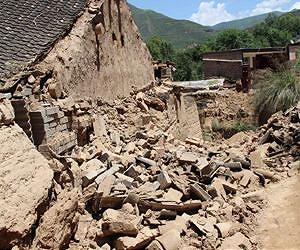
Lula is largely built from mud, from the shoulder-high walls that form narrow walkways to the foundations on which its humble houses stand.
It is a plentiful building material, another fruit of the dusty soil from which its 900-odd residents scrape a living. But when earthquake strikes it is a recipe for disaster, unable to withstand the shock.
Much of the Dong family home, passed down through generations as is typical in the Chinese countryside, was reduced to little more than piles of powder and bricks.
Weeks of heavy rain had already increased the risk of landslides, and Lula is part of Meichuan, the township worst hit by Monday's shallow 5.9- and 5.6-magnitude quakes which killed at least 94 people.
Tens of millions of China's rural residents have travelled thousands of kilometres to its booming eastern cities in recent decades in search of work and income.
Leaving their children behind — Kong, who had a sister, lived with his grandfather — they only see them once every 12 months, at the Lunar New Year.
It was only after the annual festivities this February that Kong's parents joined the exodus, and it was the last time they saw him alive.
"They had delayed leaving home for a long time, as they didn't want to leave their family, but they finally decided to go to Shanghai to make money after Chinese New Year," said his aunt Pu Huxia, sitting next to the coffin, surrounded by smouldering incense and candles.
"They had no choice but to go," she added quietly. "They had no money."
