
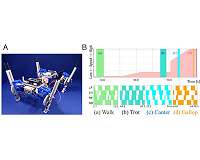
The research group of Professor Akio Ishiguro and Assistant Professor Dai Owaki of Tohoku University have, for the first time, successfully demonstrated that by changing only its parameter related to speed, a quadruped robot can spontaneously change its steps between energy-efficient patterns (gait transition phenomena).
Until now, the manner in which changing speeds cause quadrupeds to change their gaits – walking, trotting and galloping – is poorly understood. Through this study, the researchers successfully demonstrated the reproduction of the quadruped gait transition phenomena. They achieved this via a decentralized control scheme, using a simple local rule in which a leg continues to support the body while sensing weight on the corresponding leg.
Moreover, they confirmed that the energy-efficiency profile of the robot's gait patterns matched those measured in horses.
The present work is expected to lead to better understanding of the mechanism of how quadrupeds can flexibly and efficiently adjust their gait when their speed is changed. The result may constitute the basis of an unconventional approach to coordinating the many degrees of freedoms required for adaptive robot locomotion.
The researchers hope that the study will lead to a wide range of applications such as adaptive legged robots working in disaster areas, user-friendly legged entertainment robots, and automatic motion-creation algorithms for computer graphics (CG) animation.
Origami-inspired Robot Can Hitch a Ride with a Rover
The next rovers to explore another planet might bring along a scout. The Pop-Up Flat Folding Explorer Robot (PUFFER) in development at NASA's Jet Propulsion Laboratory in Pasadena, California, was inspired by origami. Its lightweight design is capable of flattening itself, tucking in its wheels and crawling into places rovers can't fit.
Over the past year and a half, PUFFER has been tested … read more
