
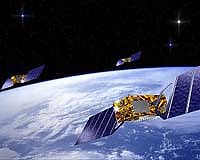
QinetiQ announced Wednesday it has signed a contract to join the European consortium conducting Phase CDE1 of development of the Galileo satellite constellation.
ESA has contracted the group to develop the Galileo second source test user segment, intended to play a crucial role in evaluation of Galileo during its in-orbit validation phase.
Galileo is Europe's equivalent of the U.S. GPS system, intended to provide a wide range of positioning services. Galileo will be compatible with GPS – as well as EGNOS, Galileo's predecessor – and is expected to be fully operational before the end of the decade with a fleet of 30 satellites.
Under its 7.3 million euro, ($9.4 million) four-year contract, QinetiQ will perform security module development and test-support-tool design, construction and use. In addition, QinetiQ's Centre for Propagation Analysis and Atmospheric Research will perform an ionospheric propagation analysis, which theoretically should validate Galileo's expected performance.
The InReach consortium, led by the Belgian company Septentrio Satellite Navigation, previously had competitively bid, won and completed the Phase C0 contract of Galileo's TUS, which addressed atmospheric propagation analysis, validation of the user requirements, receiver architecture design and specification for the test-support tools. ESA awarded Phase CDE1 as a follow-on contract.
Government and official users of Galileo will benefit from increased security and higher integrity provided by the system's Public Regulated Service, QinetiQ said in a statement.
The company's security module, which is under development, should provide the PRS Test User Receiver with access to classified functionality. Prior to delivery, the U.K. National Security Authority will evaluate and certify the module.
The TST being built by QinetiQ will be used for independent validation of the Test User Receivers being developed by the consortium.
"As one of only a few companies in Europe with the Government pedigree and capability to support the security module development and integration, QinetiQ is proud to contribute this critical element of Galileo," remarked Richard Davis, MD of QinetiQ's Comms Division. "Our independence from receiver manufacturers also makes us an ideal partner for the TUS validation to confirm this element of the Galileo system delivers the required performance."
Other consortium members include Delft University of Technology and Ursa Minor in the Netherlands, and telecom and aerospace companies Orban Microwave Products, Deimos and SkySoft.
