
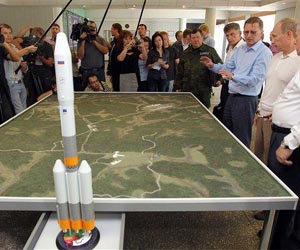
Russian Prime Minister Vladimir Putin said on Thursday a national strategy was needed for the development of the country's space launch centers. "I believe we need to develop a long-term national development strategy," he told a conference on the future of Russian space centers, speaking on Russian Cosmonautics Day.
He said about 150 billion rubles (about $5 billion) will be earmarked for space programs from the federal budget.
That includes over 40.5 billion rubles for the development of cosmodromes, he added.
"Most of the funds – about 30 billion rubles – will go to Vostochny," he said, referring to the space center under construction in the country's Far East.
Only the existence of several launch centers will guarantee Russia "complete independence in space," he said.
Russia currently uses two launch sites – Baikonur in Kazakhstan, which it has leased since the fall of the Soviet Union, and Plesetsk in northwestern Russia.
The construction of Vostochny, which began last year, is due to be completed in 2016.
The vast facility in the Amur Region will eventually include two launch pads, a training center and oxygen and hydrogen generation plants.
Russians Fear Nation Is Losing Space Race
Russia is losing its position as the leader of the space race and needs to invest more in the space industry, a new poll by Levada Center revealed to mark Cosmonauts Day on Thursday.
Forty-six percent of the respondents said Russia needs to spend more effort on its space exploration programs, compared to 36 percent who think the current level of support is enough and seven percent who advocate a cut in spending, the pollster said on its website.
Students and workers were the most ardent advocates of increased funding for the space industry. The idea was also at its most popular with backers of failed presidential candidates Vladimir Zhirinovsky and Mikhail Prokhorov.
Only 36 percent said Russia remains the leader of the space race, compared to 51 percent a year ago. Other picks included the United States, named by 29 percent of the respondents, China (11 percent) and the European Union (4 percent).
The federal space budget in Russia in 2012-2014 will stand at about 525 billion rubles ($17 billion). The country runs an extensive space program, but it suffered a number of failed launches in 2010-2011, which were blamed on lack of skilled staff in the industry after years of poor funding.
Russian Firm to Roll Out Moon Rover
The prototype of the Russian moon rover competing for the Google Lunar X PRIZE will be finished by summer, developers said on Thursday.
The Selenokhod ("Moon Walker") will then undergo extensive testing, including the vacuum camera, the vibration test bed and on a simulated moon surface complete with craters, Sergei Sedykh, the Selenokhod company head, told RIA Novosti.
Selenokhod is the only Russian entrant among 26 teams competing for the $20 million that Google and the X Prize foundation assigned in 2007 for the company to build the first successful private moon rover.
The winner has to create an unmanned probe that would successfully reach the moon, travel at least 500 meters across its surface and send high-definition video and photo from its trip back to Earth.
Russia has a history of building wheeled moon rovers, two of which operated on the moon in the early 1970s.
But the Selenokhod will move on skis, not wheels, a design initially developed for the Russian Prop-M rover, two of which were dispatched to Mars in 1971, but failed to deploy properly.
The developer plans to deliver its 5-kilogram Selenokhod to the moon via Russian probe Luna-Glob, expected to be launched in 2015, though the contest organizers have not said so far whether they think this delivery method is acceptable, Sedykh said.
