
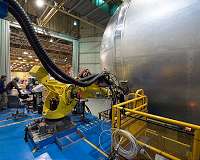
A team prepares a robot – the yellow machine attached to the liquid hydrogen tank for the Space Launch System rocket – for friction plug welding at NASA's Michoud Assembly Facility in New Orleans. Friction plug welding is a technique developed by engineers at NASA's Marshall Space Flight Center in Huntsville, Alabama.
It uses a robot to fill holes left after the tank goes through assembly in a larger robotic welder. The liquid hydrogen tank is more than 130 feet long and is the largest part of the rocket's core stage – the backbone of the rocket.
The liquid hydrogen tank, along with a liquid oxygen tank, will provide 733,000 gallons of fuel for the first integrated mission of SLS with NASA's Orion spacecraft in 2018. SLS will be the world's most powerful rocket and take astronauts in Orion to deep space, including on the Journey to Mars.
'Layering' Up for the First Flight of NASA SLS
Technicians from Janicki Industries in Hamilton, Washington, have layered out the diaphragm for the Orion stage adapter. The adapter will join the Orion spacecraft to the interim cryogenic propulsion stage (ICPS) of the Space Launch System, NASA's new rocket for the journey to Mars.
The ICPS is a liquid oxygen/liquid hydrogen-based system that will give Orion the in-space push needed to fly beyond the moon before it returns to Earth on the first flight of SLS in 2018. The adapter diaphragm is used to keep launch vehicle gases away from the spacecraft.
The diaphragm is constructed of multiple layers of carbon fiber fabric material engrained with epoxy. The layers are pieced together and carefully positioned in place using laser projectors to outline where they need to go.
Janicki finished laying the final piece in late October. The diaphragm work is being done in collaboration with NASA's Langley Research Center in Hampton, Virginia, and NASA's Marshall Space Flight Center in Huntsville, Alabama.
