
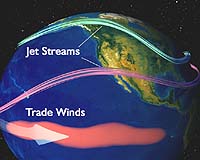
U.S. scientists are predicting we will soon enjoy precision climate modeling, offering detail and scale only imagined a few years ago. John Drake and David Erickson at the Oak Ridge National Laboratory's computer science and mathematics division say it's possible for scientists to create meteorological models that take into account such things as the complete carbon cycle, terrestrial biology, El Ninos and hundreds of other factors.
The goal is to provide what scientists call a fully integrated Earth system model that can be simulated every 15 minutes for centuries.
"Before, we had to make compromises that ultimately limited the resolution and scope of our models and subsequent predictions," said Drake. "Now, using what we have learned and with computing power exceeding 50 teraflops, we can make our models far more sophisticated."
The upgraded model will incorporate the most recent atmospheric, oceanic and glacial ice data as well as improved chemistry, biology and physics, Drake said.
The research also involves scientists at the National Center for Atmospheric Research, NASA, Duke University, Georgia Tech and various national labs to develop a climate end station.
Recent work by Erickson and colleagues appears in the journal Geophysical Research Letters.
Source: United Press International
