
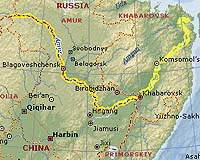
Russian scientists are continuing to register higher than normal levels of water pollution in the Amur river after last year's blast at a benzene factory upstream in northeast China, Russian television reported Sunday.
"Allowable levels of concentration for different types of phenol are being exceeded… The chlorophenol group actively exceeds the allowable level of concentration by almost 30 times," said Alexander Gavrilov, a local official from Russia's weather centre, told the NTV station.
The thawing of the ice sheet that covered the river during the winter months is leading to a second wave of pollution from the November 13 explosion at a PetroChina factory, NTV quoted experts as saying.
Chlorophenols are derived from benzene and have a strong medicinal taste and smell. They can affect the liver and the immune system, as well as increase the risk of cancer, according to the US Department of Health.
But local residents told NTV they were continuing to eat fish that smelled strongly of contaminants, despite the dangers, by adding laurel leaves and pepper when cooking to take away the stench.
"Of course it's frightening to eat the fish after the river was polluted. But we try and put more spices to take the smell away," said Viktoria Fuskhar, an inhabitant of the village of Sikachi-Alyan in Khabarovsk province.
Higher-than-normal levels of contamination have been registered in Russia's far east region since the PetroChina factory blast sent a benzene slick down the Songhua river, which feeds into the Amur river.
The Amur forms a long stretch of the border between Russia and China.
Source: Agence France-Presse
