
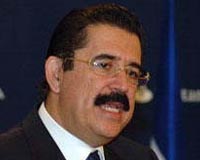
Elected President Manuel Zelaya said he will return to Honduras, despite having been removed from the country in a coup and threats that he will be arrested should he return.
Zelaya has the support of the international community, including the United Nations and the Organization of American States. He said he would travel to Tegucigalpa accompanied by a cadre of international leaders, including Presidents Cristina Fernandez of Argentina and Rafael Correa of Ecuador.
"I am going back to Honduras on Thursday, I'm going to return as president," Zelaya said Tuesday at the United Nations.
However, the current Honduran leadership promised to arrest Zelaya and prosecute him on charges of violating the constitution and having links to organized crime and drug trafficking.
"As soon as he enters he will be captured. We have the warrants ready so that he stays in jail in Honduras and is judged according to the country's laws," Honduran interim Foreign Minister Enrique Ortez told CNN International.
Zelaya left the United Nations for Washington and meetings with U.S. State Department officials. The interim government also said it would send a delegation to Washington. It is unknown if the two sides would meet.
The ouster of Zelaya was carried out by the military but with the support of the country's legislature and courts. There have been protests in support of Zelaya, but the crowds have been relatively small. Demonstrations in support of the interim government seem to be more numerous.
Zelaya was removed from office Sunday after he had ordered a non-binding referendum on proposed constitutional changes, a formal vote on which would be in November when the country has scheduled elections.
His opponents saw the changes as a move by Zelaya to seek an additional term as president. His current term ends in January.
The Honduran Constitution expressly forbids even the proposing of a change of the document's article that limits Honduran leaders to one term as president.
Zelaya's political detractors had worried that he was leading the country on a track toward socialism, much as his strong ally Hugo Chavez has taken Venezuela. (Chavez on Sunday threatened military action unless Zelaya was returned to office.)
Honduras has generally been overseen by more conservative leaders, although five of the seven presidents since 1982 have been from Zelaya's Liberal Party.
The caretaker government is led by interim President Roberto Micheletti, the speaker of the Honduran Legislature and a bitter Zelaya political opponent. Micheletti is also a Liberal Party member, but the party was involved in legislative moves looking into how to remove Zelaya from office. Honduras has no impeachment process.
Honduras, with a per capital gross domestic product of about $4,200, is one of the poorest countries in the Western Hemisphere. It was granted independence from Spain in 1821 and has been governed under its current constitution since 1982.
earlier related report
US puts off decision to cut aid to Honduras until Monday
The United States has delayed any decision to cut aid to Honduras until Monday in order to give diplomatic moves time to return ousted President Manuel Zelaya to power, a US official said Wednesday.
"We're evaluating the impact of these actions (that ousted Zelaya) on our assistance programs," a senior official in President Barack Obama's administration told reporters on the condition of anonymity.
"The focus of our assistance programs is the well-being of the Honduran people," the official said on a conference call. "That remains our focus as we conduct this evaluation."
But he added it "is important to note" that the US government is currently working with its partners in the 34-member Organization of American States (OAS) to try to restore "democratic and constitutional order" to Honduras following Sunday's coup.
"We will wait until the (OAS) secretary general has finished his diplomatic initiative and reports back to the (OAS) general assembly on July 6 before we take any further action in relationship to assistance," the official said.
The OAS general assembly instructed Secretary General Jose Miguel Insulza to undertake "diplomatic initiatives aimed at" returning Zelaya to power within the next three days.
If these efforts prove fruitless, Honduras will be barred from the OAS, in keeping with the group's charters, according to a communique issued Wednesday.
Tensions have flared in Honduras since Zelaya was deposed in an army-backed coup on Sunday and swiftly flown out of the country. The coup was the first in the major banana and coffee exporter in more than 20 years.
In fiscal year 2008, the United States provided a total of 51.4 million dollars in assistance, the State Department said. In 2009, Washington is planning to give at least 43 million dollars.
The funds are for economic development, fighting drug trafficking under the Merida Initiative and support for global peacekeeping operations conducted by Honduran troops, it said.
Under the Millennium Challenge Corporation Compact, signed in June 2005, Honduras has a five-year 215 million dollar grant, it said. Until now, more than 76 million dollars has been handed out.
It was not immediately clear how much of the aid total is considered humanitarian and therefore could not be cut if Washington decided to suspend aid.
The Pentagon on Wednesday suspended all military activities with Tegucigalpa until further notice, saying the government in Washington, where Zelaya met with US officials, for now is "assessing the situation."
The World Bank said it was halting all loans and grants to Honduras, valued at some 400 million dollars, "until there is a resolution of the present crisis."
In Santiago, Inter-American Development Bank President Luis Alberto Moreno said the lender would not be providing any new credits to Honduras after the coup there.
Share This Article With Planet Earth
