
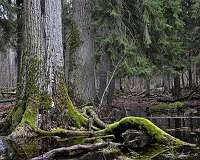
Poland on Wednesday accused the EU's top court of taking sides in a lawsuit lodged by the European Commission against it for logging in the Bialowieza Forest, Europe's last primeval woodland.
Warsaw and the Commission argued their cases on Monday before the European Court of Justice (ECJ) in Luxembourg, where Poland is accused of commercial logging in the protected UNESCO World Heritage site and failing to obey the court's temporary logging ban.
"An unprecedented incident took place during this session, and the court's vice-president(Antonio Tizzano) took the role of the plaintiff by making suggestions to European Commission representatives about the content of their motion," Poland's environment ministry said in a Wednesday statement.
Polish media maintain that Justice Tizzano only intervened in a procedural capacity when it became apparent that the commission official was ill-prepared to offer testimony.
The ministry, however, insisted that "the main objective (of ongoing proceedings) is to humiliate Poland."
Poland's right-wing government began logging in May last year, saying it was clearing dead trees to contain the damage caused by a spruce bark beetle infestation, and insisting the policy was entirely legal.
But scientists, ecologists and the EU contest the move and activists allege that it is being used as cover for the commercial logging of protected old-growth forests.
"We are respecting the temporary ban and go prove otherwise!", Poland's chief forester Konrad Tomaszewski told Polish media on Wednesday.
But during Monday's ECJ hearing, the commission representative showed photographic evidence of ongoing logging in areas protected by UNESCO and the EU's Natura 2000 programme.
The ECJ is expected to give its final ruling in the case in early October.
Chocolate industry driving deforestation of Ivory Coast: report
Abidjan (AFP) Sept 13, 2017 –
The chocolate industry is indirectly driving massive and illegal deforestation in Ivory Coast, fuelling a catastrophic decline in wildlife, a green group said Wednesday.
"In several national parks and other protected areas, 90 percent or more of the land mass has been converted to cocoa," the group Mighty Earth said in its investigation.
"Less than four percent of Ivory Coast remains densely forested," it said. "The chocolate companies' laissez-faire approach to sourcing has driven extensive deforestation in Ghana as well."
Habitat loss has been disastrous for protected species, ranging from chimpanzees and leopards to pygmy hippos and elephants, it said.
The animals are forced into ever-smaller areas, making it easier for them to be tracked down and slaughtered by poachers.
In Ivory Coast, the world's biggest cocoa producer, accounting for 40 percent of world output, "deforestation has pushed chimpanzees into just a few small pockets, and reduced the country's elephant population from several hundred thousand to about 200-400," the report said.
It said major chocolate brands were indirectly involved in a "shocking" trade, in which growers produced cocoa in national parks, who sold it to middle men, who then sold it on to a handful of firms that control roughly half of the world's market.
From there, it was sold to big chocolate companies.
"According to our analysis, 291,254 acres (117,900 hectares) of protected areas were cleared between 2001 and 2014," Mighty Earth said.
Over the same period, Ghana, another big West African producer, lost 7,000 square kilometers (2,700 square miles) of forest, or about 10 percent of its entire tree cover.
Around a quarter of that deforestation in Ghana was connected to the chocolate industry, the report charged.
Traders Cargill, Olam and Barry Callebaut, which are named in the report, say on their websites that they are aware of the problem of deforestation in the cocoa sector, and have set up to programmes for deforestation-free supply chains.
Leading chocolate and cocoa companies, under an initiative launched by Britain's Prince Charles, have promised to come up with a "framework of action" to end deforestation in the industry.
Their project is due to be unveiled for the world climate conference in Bonn in November. Deforestation is not only destroys habitat, but is also a major contribution to global warming.
The world demand for chocolate stands at around three million tonnes annually, a figure that rises between two and five percent each year, in a market worth around $100 billion (84 billion), according to the report.
Most of it is is manufactured and consumed in Europe and North America.
Chocolate industry driving deforestation of Ivory Coast: report
The chocolate industry is indirectly driving massive and illegal deforestation in Ivory Coast, fuelling a catastrophic decline in wildlife, a green group said Wednesday.
"In several national parks and other protected areas, 90 percent or more of the land mass has been converted to cocoa," the group Mighty Earth said in its investigation.
"Less than four percent of Ivory Coast remains den … read more
