
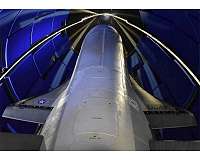
With the X-37B robot spaceplane about to fly its sixth mission, it's worth considering how its flight has been planned. Some aspects of the mission are fairly predictable. It will spend extended periods in a normal, fairly circular orbit, and occasionally make slight changes.
This slow vigil will probably continue for several months. With a Service Module attached to its rear, the X-37B has never been so large or less agile. This suggests that the flight plan for the first phase of the mission will be fairly conservative.
Over the course of this phase, experiments will be conducted at a regular pace, and some of them will operate continuously. A satellite will be deployed from the Service Module at a fairly early stage in the mission. There's probably no reason to keep it hangered for too long. But apart from that, trackers will probably have a fairly boring time in their observations.
The satellite deployment and extended loitering in orbit suggest that X-37B will be in a relatively high low Earth orbit, to reduce atmospheric drag. This will save fuel for the spaceplane and also extend the orbital life of the small US Air Force satellite it will deploy.
Material tests on board the X-37B are probably designed for spacecraft operating at reasonably high altitudes. Better to keep them out of the upper atmosphere for an extended period.
But changes could come in the second phase of the mission. This analyst predicts that the Service Module could be detached well before the X-37B is due to return to Earth. Unlike other spacecraft that use them, X-37B can function as an independent spacecraft without its Service Module.
No previous mission of this spaceplane has carried one. This analyst also suggests that the Service Module itself could probably fly its own mission without being attached to the X-37B. So far from being a traditional Service Module, we have two tandem spacecraft that will eventually undock.
This would leave the X-37B in a smaller and more atmospheric mode, ready to perform the sort of tactical moves in the upper atmosphere that were used on its previous mission. The spacecraft would dip to altitudes where satellites don't normally go and then emerge on a different trajectory.
This will confuse trackers, both amateur and professional. It will also prompt a lot of searching as attempts are made to find the spacecraft in its new orbit.
But how long will the mission last? The last flight of X-37B went for an astonishing 780 days. Every successive mission has outlasted its predecessor. Will the Pentagon try to break another endurance record for the spaceplane?
This analyst suggests that it won't happen. The X-37B has already shown its worth as a long-endurance spacecraft. At some point, the record-breaking has to stop. The law of diminishing returns will apply to an extended mission.
An excessively long flight could ruin some of the materials samples and even the seeds carried on board. Also, it could delay further progress in evaluating the results of this mission and preparing for the next.
Despite the information that has been released for this mission, the Pentagon is still keeping its cards close to its chest. We won't know the full extent of the mission until it actually ends.
