
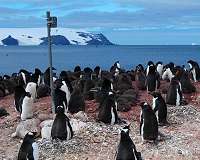
Penguins that only eat krill are more vulnerable to impacts of climate change, according to a new study.
Krill, small shrimp-like crustaceans, are a vital resource for penguins, seals and whales in Antarctica. But new research suggests some are more partial to the mini arthropod than others.
When researchers from Canada and the United States plotted penguin population changes over the last several decades, they found gentoo penguins are thriving, while chinstrap penguin numbers continue to decline.
By analyzing the nitrogen isotope values of amino acids in penguin feathers collected over the last century, scientists were able to track the diets of gentoo and chinstrap penguins. The data, detailed this week in the journal PNAS, showed the gentoo penguin's diet has become increasingly varied over the last few decades, while the chinstrap penguin continues to rely almost exclusively on krill.
Because the chinstrap penguin's diet is so picky, the species is especially vulnerable to the impacts of climate change and human activities.
"When seal and whale populations dwindled due to historic over-harvesting, it is thought to have led to a surplus of krill during the early to mid-1900s," study co-author Michael Polito, researcher at Louisiana State University, said in a news release.
Scientists theorized that the abundance of krill spurred an explosion of the gentoo and chinstrap penguin populations.
"In more recent times, the combined effects of commercial krill fishing, anthropogenic climate change, and the recovery of seal and whale populations are thought to have drastically decreased the abundance of krill," Polito said.
As krill numbers declined, isotopic data showed gentoo penguins began eating more and more fish and squid. Chinstrap penguins failed to make the same adjustments. As a result, their numbers have suffered.
"Since the 1930s, human activities have reduced the population of chinstrap penguins by 30 to 50 percent. That's accompanied by increases in the gentoo population of up to 600 per cent in some locations," said University of Saskatchewa researcher William Patterson. "This has implications for future populations, where the specialists are more likely to be endangered by human activities and variability in the natural environment."
Spray-painted polar bear sparks alarm in Russia
Moscow (AFP) Dec 3, 2019 –
A video showing a polar bear daubed with painted slogan T-34, the name of a Soviet era tank, has caused alarm in Russia with experts saying it could prevent the bear hunting.
Local media reported Tuesday that scientists had marked the bear because it was scavenging for food near a human-inhabited area in the Arctic region.
The video was posted on Facebook on Monday by Sergei Kavry, who works for the World Wildlife Fund in the Chukotka region.
He said he was concerned at the large letters daubed on the side of the bear, seen plodding through snow.
"Why? Why? He won't be able to hunt inconspicuously," Kavry wrote. Kavry said he found the video on a WhatsApp social media group and did not know where it was shot.
A senior researcher at the Institute of Biological Problems of the North in far eastern Russia, Anatoly Kochnev, told RIA Novosti news agency he did not know where the video was shot, but the letters could have been painted on by "jokers."
"At first, until he cleans himself off, it will be hard for him to hunt," the scientist said.
Severpress news agency, based in the Yamalo-Nenetsky region, some 2,000 kilometres (1,250 miles) northeast of Moscow, reported that the marks were put on by an expedition of scientists on Novaya Zemlya, a remote and sparsely populated Arctic archipelago.
It cited experts as saying a team of scientists from Moscow went to investigate a polar bear that was raiding a settlement's rubbish tip and they marked the bear to see if it returned.
The agency quoted Ilya Mordvintsev, a senior researcher from Moscow's Institute of Problems of Ecology and Evolution, as saying the expedition members caught the bear and sedated it.
Finding the animal was well-fed and therefore would not attack humans, they took it to a safe distance from the settlement and marked it with paint that would wash off in two weeks, to see if it returned to scavenge, he said.
The video was apparently shot last week, the agency reported.
Polar bears regularly visit areas inhabited by humans in Arctic Russia to search for food, often in rubbish tips.
In February in Novaya Zemlya, officials sounded the alarm over an "invasion" of 52 bears in the main settlement there.
The bears are affected by global warming with melting Arctic ice forcing them to spend more time on land where they compete for food.
