
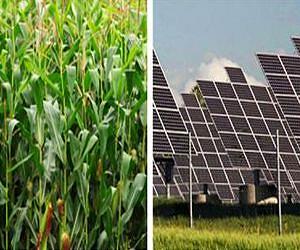
Which is more efficient at harvesting the sun's energy, plants or solar cells? This salient question and an answer are the subject of an article published in the May issue of the journal Science.
Although both photosynthesis and photovoltaics harvest energy from the sun, they operate in distinctly different ways producing different fuels. It is not a simple task to find common ground between the two in order to compare energy conversion efficiency.
"In order to make meaningful comparisons between photosynthesis (which provides stored chemical potential) and photovoltaic technology (which provides instantaneous electrical power), we considered photovoltaic driven water electrolysis to yield hydrogen using existing technology as an example of artificial photosynthesis," explained co-author Thomas Moore, director of the Center for Bioenergy and Photosynthesis at Arizona State University.
"The hydrogen produced by the artificial system is thermodynamically equivalent to the sugar produced by photosynthesis. The take-home from this point is that the artificial system out performs the natural one, but on the basis of potential for efficient solar energy conversion as measured by the land area required for a given energy output, both technological and biological processes could in principle offer similar outcomes."
Photovoltaic technology uses fundamental principles combined with advances in materials to achieve record efficiencies of solar-to-electrical power conversion and thereby hydrogen production from water electrolysis.
The cost to the biosphere of "our cut" of NPP is driving several Earth systems irreversibly across boundaries that were established over geological time scales, says Moore. Earth systems affected include the nitrogen cycle, carbon cycle, fresh water, land use, and an increase in the rate of biodiversity loss.
In other words, photosynthetic energy flow is currently booked (almost certainly overbooked) for biosphere services including food and limited bioenergy production for human use. As a consequence, there are no reserves of photosynthetic capacity to provide increasing amounts of biofuel for growing our GDP and food for the ever-increasing human population. Indeed, when such demands are made, the capacity comes at the further peril of biosphere services.
"Fortunately, the efficiency of photosynthetic NPP could be dramatically improved to meet human needs – the 133 terawatts increased to about 150 terawatts with minimum additional impact on Earth systems," explains Moore excitedly.
"I'm thinking about selected photosynthetic systems in which rational design, based on the principles demonstrated in artificial systems, could be used to optimize solar-to-biofuel conversion efficiencies to meet particular needs."
"Such photosynthetic systems would be 'living' in that they would retain key features of living cells including self-assembly, repair, replication and the use of Earth-abundant materials – features that I think are essential to scale and match sustainable energy production to local needs but that remain elusive to non-living, human engineered constructs," concludes Moore.
Share This Article With Planet Earth
