
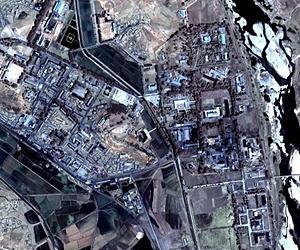
North Korea has made significant progress in building a new nuclear reactor but it is unlikely to become operational for two to three years, according to a website which published satellite photos.
Pyongyang's official news agency said last week the light-water reactor at the Yongbyon complex would start operating soon but gave no date.
The North says the experimental reactor and an associated uranium enrichment plant are designed to provide electricity, but scientists say they could be reconfigured to produce material for nuclear weapons.
The US State Department Tuesday raised concern at the projects, saying they breach UN resolutions.
The 38 North website (38north.org), which is devoted to analysis of the North, this week carried satellite images of the work in cooperation with DigitalGlobe's Analysis Center.
It said "significant progress" over the past year could indicate a desire to push ahead as fast as possible with uranium enrichment, to produce fuel for the reactor and possibly fissile material for weapons.
The website said the plant's exterior could be completed in 6-12 months.
But operations were unlikely to start for another 2-3 years because Pyongyang still needed to complete construction, finish loading machinery and equipment, install electronics in the control room and produce fuel assemblies.
The reactor and the uranium enrichment plant were disclosed to US scientists who visited Yongbyon on November 12, 2010.
One of them, Siegfried Hecker, said both facilities appeared designed mainly for civilian nuclear power.
But he said the enrichment programme could readily be converted to produce highly-enriched uranium for bombs and the reactor could be run to produce plutonium.
The website 38 North said there was also serious concern about whether the new reactor complies with international safety standards in light of the disaster at Japan's Fukushima plant.
The United States and its allies demand that Pyongyang shut the enrichment plant before six-nation talks on the North's nuclear disarmament can resume.
Pyongyang's existing plutonium stockpile — estimated to be enough for six to eight atomic bombs — came from a decades-old gas graphite reactor at Yongbyon that was shut down in 2007 under a six-party accord.
