
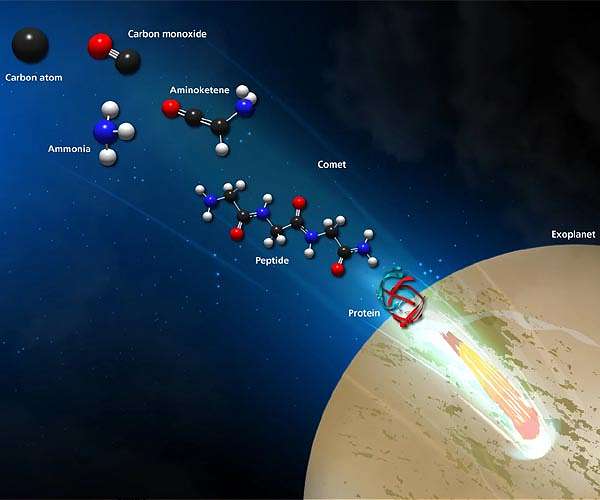
Organic compounds vital for life, peptides, which are integral to numerous biological functions, have been found to form on cosmic dust particles even in environments thought inhospitable due to the presence of water. This discovery was made by Dr. Serge Krasnokutski and his team at the Max Planck Institute for Astronomy's Astrophysics Laboratory in collaboration with the University of Poitiers.
Replicating cosmic conditions in a laboratory vacuum, Krasnokutski's group confirmed the ability of amino acid precursors, aminoketenes, to form peptides on molecular ice. Contrary to prior assumptions, the presence of water, which typically coats interstellar dust, does not prevent peptide formation but only reduces its efficiency by fifty percent-a minor setback given the vast timescales of cosmic events.
"The presence of ammonia, atomic carbon, and carbon monoxide among the molecular clouds allows for the necessary chemical reactions to occur, leading to the creation of simple peptides," said Krasnokutski. Despite the water-related challenges, the detailed mass spectrometric analyses performed in France demonstrate that peptide formation continues at significant rates.
This revelation adds to the ongoing debate about whether life's initial biomolecules originated from terrestrial or extraterrestrial sources, suggesting that the cosmos might play a role in the emergence of life on Earth.
Research Report:Formation of extraterrestrial peptides and their derivatives
