
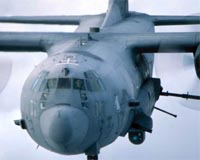
The United States acknowledged Tuesday it had carried out its first known military action in Somalia since 1994, but called it a targeted air strike on Al-Qaeda's main leaders in the region. A Pentagon spokesman confirmed that an AC-130 gunship was used to attack "principle Al-Qaeda leadership in the region" in southern Somalia early Monday and left open the possibility of more attacks in the future.
Among the senior Al-Qaeda figures were one or two believed to be responsible for the 1998 bombings of US embassies in east Africa, but it was unclear whether they were among those hit in the attack, a US official said.
"We are going to pursue those people that are responsible, those individuals, those terrorists that are responsible for the bombings in Kenya and Tanzania," said Bryan Whitman, a Pentagon spokesman.
At the White House, spokesman Tony Snow said the attack was "a reiteration of the fact that people who think that they're going to try to establish a safe haven for Al-Qaeda any place need to realize that we're going to fight them."
Whitman would not comment on reports from Somalia of a second attack reportedly involving at least two helicopter gunships a day later, although he indicated US forces were not involved.
"We acknowledge the fact that the United States military did conduct a strike in Somalia on Sunday," Whitman said. Pentagon officials later clarified that it was conducted early Monday Somali time.
"The target of the strike we believe was the principal Al-Qaeda leadership in the region."
It was the first known US military strike in the country since the withdrawal of US forces there in 1994, and follows a rout of Islamist forces by Ethiopian and Somali government forces.
But US officials said the attack was in response to an opportunity that had presented itself, rather than part of a broader US military engagement in Somalia.
"It was a target of opportunity we had to take," said a US official, who spoke on condition of anonymity.
The State Department meanwhile confirmed that Assistant Secretary of State Jendayi Frazer cancelled plans to visit Mogadishu just hours before the strike, meeting with members of the Western-backed interim Somali government in neighbouring Kenya instead.
"Given the security situation on the ground, frankly it (the visit) wasn't possible," department spokesman Sean McCormack told reporters.
Senator Carl Levin, chairman of the Senate Armed Services Committee, told reporters Monday's operation appeared to be a discrete anti-terrorist operation rather than a sign of a deeper US military involvement in the Somalia conflict.
Levin said the targets were Al-Qaeda militants thought to have carried out the 1998 embassy bombings which killed 224 people.
"I think the targets were tracked probably with some high technology equipment and satellites," he said, but asked for details added, "I may be wrong. I think I just speculated."
Among the Al-Qaeda figures believed to be operating in Somalia are Fazul Abdullah Mohammed and Saleh Ali Saleh Nabhan, who the US believes were responsible for the embassy bombings.
Another is Abu Talha al-Sudani, a Sudanese alleged to be an explosives expert close to Al-Qaeda leader Osama bin Laden.
The US official said the military believed that they had in their sights at least a couple of the four or five senior Al-Qaeda leaders in Somalia.
But he added, "We still don't know who they are."
Whitman declined to say whether any Al-Qaeda leaders were killed, or to more precisely identify the targets of the attack.
Somali village elders said at least 19 civilians had been killed in the gunship attack on two villages in Somalia's southernmost tip — Badel and Aayo.
Whitman said the operation was prompted by "credible intelligence that led us to believe we had principal Al-Qaeda leadership in an area where we could identify them and take action against them."
He would not comment directly on the reports from Somalia of a second attack involving helicopter gunships, which Somali officials said targeted a terrorist command and control facility on Tuesday.
The Pentagon provided no other details on the operation itself, but Whitman stressed the US military conducts "all our operations in close cooperation with allies in the region."
earlier related report
US leads fresh raids on Al-Qaeda forces: Somali official
Mogadishu (AFP) Jan 09 – Somalia said the US had launched fresh air strikes on suspected Al-Qaeda targets in the south of the country on Tuesday, amid international criticism that they risk further destabilising the lawless Horn of Africa nation.
A Somali defence ministry official said at least US two helicopters gunships struck targets in the same area where an US AC-130 rapid firing aircraft had pounded two villages the previous day.
The Pentagon on Tuesday acknowledged that attack, but declined to confirm the Somali claims of the second attack, indicating US forces were not involved.
Somali village elders said at least 19 civilians had been killed in Monday's AC-130 attack on two villages in Somalia's southernmost tip — Badel and Aayo.
Pentagon spokesman Bryan Whitman said the operation was prompted by "credible intelligence that led us to believe we had principal Al-Qaeda leadership in an area where we could identify them and take action against them."
"We are going to remain committed to reducing terrorist capabilities when and where we find them," he said. "The operation two days ago was an example of that."
A Somali defence ministry official told AFP the fresh attack Tuesday by at least two helicopters "was aimed at destroying the command and control facility of the terrorists.".
The US military intervention — its first in Somalia since the early 1990s — followed an offensive by Ethiopian-backed Somali government forces that routed Islamist fighters who Washington accused of harbouring senior Al-Qaeda operatives.
In Europe there was criticism of the US strikes and warnings that they could only serve to exacerbate an already volatile situation in Somalia.
"Any incident of this kind is not helpful in the long term," said Amadeu Altafaj, spokesman for EU Development Commissioner Louis Michel, while Italian Foreign Minister Massimo d'Alema stressed Rome's opposition to "unilateral initiatives that could spark new tensions."
New UN chief Ban Ki-moon said he was "concerned" about the air strikes and the "new dimension this kind of action could introduce to the conflict," his spokeswoman said.
Michele Montas said the new UN secretary general, who assumed his post on January 1, was also "concerned the impact this could have on the civilian population in southern Somalia and regrets the reported loss of civilian life."
Norway, a member of the international contact group on Somalia, said Washington's explanation of its conduct in Somalia was "not sufficient" and said the fight against terrorism should be fought in a courtroom and not with military hardware.
The level of instability in Somalia was highlighted by gunmen on Tuesday firing rockets into a camp housing Ethiopian troops in the capital Mogadishu, sparking an intense exchange of fire that killed at least two people.
It was the second such attack in three days. Islamist leaders had vowed to wage a guerrilla war following their defeat at the hands of the joint Ethiopian and Somali government forces.
Somali President Abdullahi Yusuf defended the US air raids which came after the Somali Ayr subclan allegedly refused to disclose the whereabouts of three senior Al-Qaeda operatives that Washington accused it of sheltering.
Fazul Abdullah Mohamed, a native of the Comoros Islands, Kenyan Saleh Ali Saleh Nabhan and a Sudanese national, Abu Taha al-Sudan, are accused of organising the 1998 bombing of the US embassies in Nairobi and Dar es Salaam, killing at least 224 people, most of them Africans.
"The Americans had a right to carry out the air strikes on some Al-Qaeda members," Yusuf told reporters in Mogadishu.
"Those who carried out attacks on the US embassies in Kenya and Tanzania were there, so it was the right thing and the right time to carry out such strikes," Yusuf said.
"The Americans are cracking down on Al-Qaeda terrorists all over the world and this was part of it," he added.
Yusuf, who took office in 2004, returned to Mogadishu on Monday for the first time in 20 years.
The last case of overt US military intervention in Somalia ended in 1994 with the final withdrawal of US forces from the UN-backed Operation Restore Hope following heavy losses in what was dramatized in the book and film "Black Hawk Down."
earlier related report
UN, EU lead criticism of US strike on Somalia
Paris (AFP) Jan 09 – The United Nations and European Union led international criticism Tuesday of the US air strikes on Somalia amid fears they could contribute to an escalation of the conflict in the Horn of Africa.
New UN chief Ban Ki-moon said he was "concerned" about the air strikes and the "new dimension this kind of action could introduce to the conflict, and the possible escalation of hostilities that may result," his spokeswoman said.
Michele Montas said the new UN secretary general, who assumed his post on January 1, was also "concerned the impact this could have on the civilian population in southern Somalia and regrets the reported loss of civilian life."
The EU said the air strikes, on suspected Al-Qaeda hideouts in southern Somalia, were "not helpful".
"Any incident of this kind is not helpful in the long term," said Amadeu Altafaj, spokesman for EU Development Commissioner Louis Michel.
The key to security in the region was to have Ethiopian troops, fighting Islamist forces on behalf of a weakened Somalia transitional government, withdraw from Somalia, and having an international force take their place to monitor a ceasefire, said Altafaj.
The United States confirmed earlier it had launched an air strike on suspected Al-Qaeda hideouts in southern Somalia in its first overt military intervention in the lawless nation since the early 1990s.
According to witness accounts, at least 19 civilians were killed.
Separately, Italy and Norway — both members of the international contact group on Somalia — sharply criticised the attack.
Italian Foreign Minister Massimo d'Alema said Rome was opposed to "unilateral initiatives that could spark new tensions in a region that is already highly unstable."
"Italy considers that international institutions, including those of a regional nature, should step up efforts conducive to a process of pacification within the country and with neighboring countries," he added.
Norway said Washington's explanation of its conduct in Somalia was "not sufficient" and said the fight against terrorism should be fought in a courtroom and not with military hardware.
"We support the fight against terrorism but we think that the best way to pursue the fight is in a court of law," Norwegian foreign ministry undersecretary Raymond Johansen told public service radio NRK.
"The explanations provided by the US are not sufficient," he added.
Source: Agence France-Presse
