
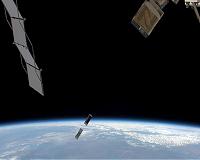
Small spacecraft technology has come of age in the past several years. Both cost and development time have been reduced significantly, especially with the CubeSat size standard of 10 x 10 x 10 cm size and maximum mass of 1kg.
Current CubeSat standards allows two or three cubes to be"stacked"to construct 2-U and 3-U CubeSats, respectively. One significant advantage of such systems is that they have opened space exploration to smaller organizations and university student teams.
To keep costs low, CubeSats represent high-risk designs that suffer from severe constraints in terms of component size, mass and power. Nevertheless, the lure of low-cost space systems has encouraged novel and innovative spacecraft designs.
One challenging area of particular interest is attitude control. Many have tried to scale down these systems from large-spacecraft designs, because active control systems are well understood and widely used.
For CubeSats, the challenge is one of miniaturizing attitude control actuators such as momentum storage devices. Thus, passive methods of control have been widely investigated. Approaches include magnetic, aerodynamic and gravity-gradient stabilization. These methods require no moving parts and use little-to-no power.
The use of passive devices for stabilization does simplify the design. However, the performance of any given design is a function of its attitude control response to environmental disturbances.
These torques depend on the selected orbit, satellite geometry and mass properties. For example, orbit inclination affects the ability of magnets to efficiently interact with the Earth's magnetic field. Lower altitudes lead to more effective aerodynamic properties. Gravity gradient devices work best in circular orbits at low altitude.
Obviously, the problem of small spacecraft attitude stabilization is complex and evolving. Launchspace offers customized general and advanced training programs on subjects such as satellite attitude control technologies, operations and systems.
