
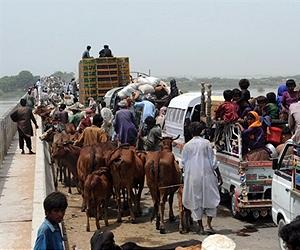
A UN refugee official suggested on Tuesday that Pakistan's geopolitical stability was at stake unless international aid accelerates to help about 20 million Pakistanis hit by devastating floods.
The office of the UN High Commissioner for Refugees (UNHCR) said that the situation remained "critically difficult" in some areas, while shelter and recovery for hundreds of thousands of people was still short nearly 10 weeks since flooding began.
"We need to draw the international community's attention that the emergency in Pakistan is not over," said Mengesha Kebede, the UNHCR's representative in the country.
"Making sure 20 million people are rehabilitated I think is an international obligation: we are looking at a geopolitical situation where the stability of Pakistan we feel is in everybody's interest," he told journalists in Geneva.
Donors have so far funded just one-third of the 2.0 billion dollar UN aid appeal, while the UNHCR's shelter needs are only half funded, a situation Kebede dismissed as "unacceptable."
In hard-hit Sindh and Baluchistan provinces, a total of about 2.7 million people are still displaced.
Kebede underlined that about 600,000 displaced had sought shelter in schools in Baluchistan, where local authorities wanted to reopen them to start schooling again.
However, many of the displaced could not return to damaged homes and supplies to set up huge tented camps were short.
"That kind of challenge continues on a daily basis in every province," Kebede added.
UNHCR is also caring for the world's largest refugee population in Pakistan, some 1.7 million Afghan refugees, many of whom were in flood hit areas.
Another 1.2 million Pakistanis are still displaced by conflict in the northern Khyber Phatunkhwa province.
"That problem has become secondary because of the magnitude of the floods. Now that the floods have started receding it will definitely start surfacing again because the conflift continues," said Kebede.
Pakistan's fraught political climate has been scarred by violence in recent years, while the country's anarchic northwestern tribal belt remains a reputed hideout for foreign and homegrown militants linked to the Taliban and Al-Qaeda.
Last month an unemployed father of four who lost his home in the floods died after setting fire to himself outside the prime minister's home.
earlier related report
Haitians unexcited for first post-quake vote: poll
Port-Au-Prince (AFP) Oct 5, 2010 –
Haitians are unmotivated by presidential and legislative elections scheduled for November 28, the first since January's devastating earthquake, according to a new opinion poll.
The survey released Monday in Port-au-Prince, found more than 20 percent of some 6,000 people questioned said they either did not know who was running for office, or had not decided who to vote for.
Of the 19 candidates vying to replace outgoing President Rene Preval, whose term expires February 7, 2011, the current frontrunner is Myrlande Manigat, with some 16 percent of voter support.
Manigat is a former first lady, whose husband was ousted from power by a coup in 1988 after just 120 days as president.
Jude Celestin, the ruling party's candidate, is running in second place with some 13 percent of the vote, according to the poll, which was conducted in September but released Monday.
In third place is popular singer Michel Martelly, who currently has support from 12.5 percent of the electorate.
Some 4.5 million people are eligible to vote in the elections, including many still living in camps after their homes were destroyed by January's devastating quake.
The 7.0-magnitude earthquake killed more than 250,000 people and left 1.5 million homeless.
Preval has expressed concern recently that the elections will attract low voter turnout, noting that "many people who are suffering do not perhaps think of voting as their primary concern."
Share This Article With Planet Earth
