
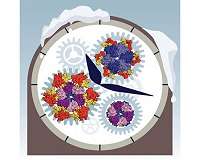
Ten years ago, researchers discovered that the biological clock in cyanobacteria consists of only three protein components: KaiA, KaiB and KaiC. These are the building blocks – the gears, springs and balances – of an ingenious system resembling a precision Swiss timepiece.
In 2005, Japanese scientists published an article in Science showing that a solution of these three components in a test tube could run a 24-hour cycle for days when a bit of energy was added. However, the scientists were not able to uncover the exact operation of the system, despite its relative simplicity.
How could the scientists resolve the working of the individual pieces? "In the end, the trick to understand the ticking biological clock in cyanobacteria was to literally make time stop", tells research leader Albert Heck from Utrecht University.
"Or as William Faulkner, Nobel Prize Laureate in Literature said: 'Only when the clock stops does time come to life.' Faulkner spoke taking a pause in the constant haste of life. That was also the trick here. We slowed the biological clock by running it in the fridge for a week. In the literal sense we have frozen the time."
In addition to stopping time, the researchers applied a new combination of cutting-edge research techniques. With one technique, they were able to determine how often each of the three protein complexes – KaiA, KaiB and KaiC – assembled or disassembled in a single 24-hour cycle. This taught them which collections of protein components – combinations of gears, springs and balances – determine the daily rhythm.
They then stopped the clock at specific moments by reducing the temperature. This allowed them to use a variety of techniques to zoom in in great detail on the structure of the collection of protein components at that moment – the position of the gears, springs and balances.
In so doing, they identified the two structures that are vital to understanding how the clock works. The researchers could then derive how the wheels turn by determining the transitions from one structure to another. This produced a model that shows exactly how only three protein components form a precision timepiece that operates on a 24-hour cycle.
"Even though the biological clock of cyanobacteria is very old in terms of geological history, we can still learn a lot from the system today," says Heck. Just a few years ago researchers discovered a similar process in our red blood cells.
"Cyanobacteria are the first organisms that have produced oxygen. Oxygen enrichment was the foundation for today's life. With the results of this study, we are learning about the biological primal mechanisms of life, but we can pursue specific aspects directly in clinical research," Heck summarizes.
Fossil or inorganic structure? Scientists dig into early life forms
An international team of researchers discovered that inorganic chemicals can self-organize into complex structures that mimic primitive life on Earth.
Florida State University Professor of Chemistry Oliver Steinbock and Professor Juan Manuel Garcia-Ruiz of the Consejo Superior de Investigaciones Cientificas (Spanish National Research Council) in Granada, Spain published an article in Wedne … read more
