
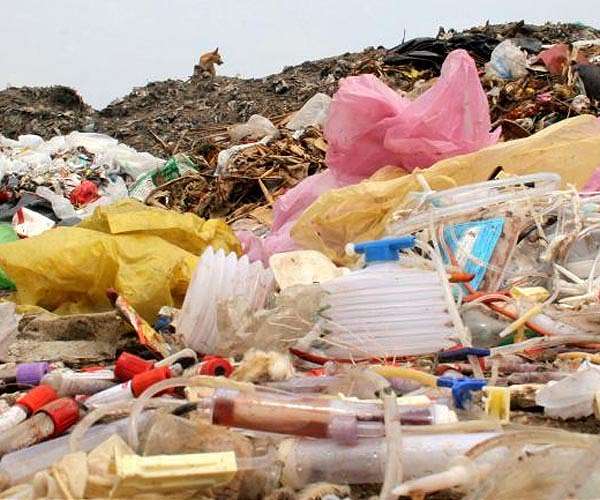
In blistering heat, several dozen volunteers are busy collecting plastic bottles, bags and polystyrene boxes as they launch a cleanup of the longest beach in Lagos.
Nigeria's megacity of 20 million people produces between 13,000 and 15,000 tonnes of waste per day, including 2,250 tonnes of plastic, according to a Lagos recycling startup, WeCyclers.
Despite recent cleanup efforts and an emerging recycling sector, Lagos has no rubbish sorting system, and lack of public awareness about pollution presents a huge environmental challenge.
Litter in Africa's most populous city gets whisked away by the rains and waterways and ends up in piles of trash on the sprawling beaches.
Lighthouse Beach stretches for about 100 kilometres (60 miles) along the Atlantic, all the way to neighbouring Benin. Lined with palm trees, the beach could be heavenly — if it weren't for all the pollution.
"It's time we raise awareness about keeping the environment clean, especially with all the plastic," said Chioma Chukwura, a marketing consultant helping to pick up garbage on the beach.
At the end of a tiring day, 230 large bin bags are piled up on the hot sand, filled with dirty plastic.
"A recycling company will come and pick them up tomorrow," said Owoade Yussuf, organiser of the cleanup. "All the plastic here will get recycled."
Sold for $500 (420 euros) a tonne, recycled plastic could bring $250 million to Lagos each year, she argued. And a cleaner environment could bolster other sectors.
Yussuf said Nigerians could be encouraged to adopt the beach lifestyle, something that would improve the livelihood of local communities.
"However, to attract people to the beach, you need a clean beach," she pointed out.
As the volunteers leave at the end of the day, just 100 metres (yards) is "clean." There is still a lot to do.
"Maybe two months, constantly, every day, to get this cleaned up," said another volunteer, Ebube Nwosu, who works in IT.
"And we have to find a way to prevent it (the plastic) from coming back. After we are done, I'm sure when we come back, we may still see litter here."
Experts with France's National Centre for Scientific Research (CNRS) reported in February that about 10 million tonnes of plastic end up in the world's oceans each year.
But at Lighthouse, the issue isn't just plastic. Rusting shipwrecks pollute the beaches, abandoned by their international owners to avoid paying for scrapping them as required by global environmental norms.
With that kind of giant pollution, even an army of volunteers may struggle. But they are hopeful that with more help they can make a difference.
Another collection is planned for June or earlier, Yussuf said.
"Hopefully we can get 100 volunteers for the next cleanup and also involve the local community there and finish it up."
Tunisians protest demanding Italy take back waste
Tunis (AFP) April 1, 2021 –
Several dozen Tunisians protested on Thursday outside the Italian embassy in Tunis to demand the return of nearly 300 containers of household waste illegally imported from Italy last summer.
Protesters wrote "take back your shit" in Italian on a large banner and put rubbish bags topped with flowers outside the embassy.
"We want you (Italian authorities) to take back your waste," Hamdi Chebaane, an expert in waste recovery and a member of a coalition of environmental associations, told AFP.
"We welcome you with flowers and you welcome us with waste," he said, calling as well on Tunisian authorities to make "the right decisions" to return the refuse.
The 282 containers from Campania, in southern Italy, are still in the port city of Sousse, where dozens of protesters demonstrated last week.
Tunisian customs officials last year seized the containers that had been imported by a Tunisian company in the guise of plastic scrap for industrial recycling.
But the containers were found to contain household waste, which is barred from import under Tunisian law.
The scandal prompted the sacking and arrest of Tunisian environment minister Mustapha Aroui, who along with 25 other people, eight of them in detention, are facing prosecution.
The manager of the Tunisian import firm is still at large. The company had signed a contract with an Italian firm for the disposal of up to 120,000 tonnes of waste at a price of 48 euros ($57) per tonne for a total of over five million euros.
The case shines a spotlight on the global trade in waste as richer countries dump their garbage on poorer ones which, like Tunisia, are often ill-equipped to deal with it.
