
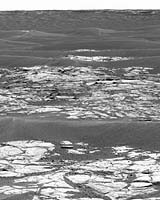
Opportunity is healthy and is observing outcrops of "Erebus Crater." The rover used the tools on its robotic arm to examine an outcrop area named "Olympia."
Sol Summaries
Sol 633 (Nov. 4, 2005): Opportunity took microscopic images of target "Kalavrita" before using the rock abrasion tool to grind the surface off of the target. After the grind, the rover took microscopic images of the exposed interior and began using the Moessbauer spectrometer on the target.
Sol 634: The rover examined Kalavrita with the Moesssbauer spectrometer during the day and with the alpha particle X-ray spectrometer at night.
Sol 635: The Moessbauer spectrometer resumed an integration at Kalavrita.
Sol 636: Opportunity successfully used the miniature thermal emission spectrometer for the first time since sol 609. Extra precautions were taken by the operations team to allow quick recovery in the case of a reset.
Sol 637: Tasks were integration with the Moessbauer spectrometer and remote sensing with the panoramic camera.
Sol 638: Opportunity used the microscopic imager, the rock abrasion tool's brush, and the alpha particle X-ray spectrometer at a target dubbed "Ziakas."
Sol 639: Opportunity drove approximately 6 meters (about 20 feet) to a cluster of cobbles.
Sol 640 (Nov. 11, 2005): The rover conducted untargeted remote sensing.
Looking ahead: Sols 641 to 643 are planned as a robotic-arm campaign on a cobble target called "Agrafa."
As of sol 639 (Nov. 10, 2005), Opportunity had driven 6,424 meters (3.99 miles).
