
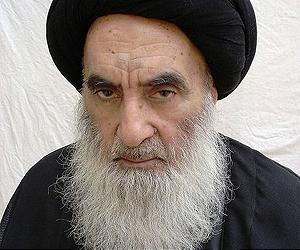
President Barack Obama has sent a letter to Iraq's top Shiite cleric, Ayatollah Ali al-Sistani, urging him to persuade the country's squabbling political leaders to form a new government, Foreign Policy magazine reported Friday.
The magazine's online edition, which cited an unnamed individual briefed by members of the cleric's family as its source, said that the letter was delivered to Sistani by a Shiite member of the Iraqi parliament.
Obama sent the letter shortly after a failed attempt by Vice President Joe Biden to settle the dispute over the new government during a visit to Baghdad July 4, the report said.
A White House spokesman had no comment on the report, and a spokesman for Sistani's office in Najaf also declined to comment.
The political impasse in Iraq comes as US forces are drawing down their numbers to 50,000 troops by the end of the month despite simmering political violence.
Former prime minister Iyad Allawi's party edged out a coalition led by Prime Minister Nuri al-Maliki in March parliamentary elections, but neither won a majority and negotiations on a new government have stalled.
earlier related report
Iran meddling to fill void in Iraq government: poll
Baghdad (AFP) Aug 7, 2010 –
Iran more than any other foreign state is meddling to fill a void in Iraqi politics five months after a general election left the war-wracked nation without a new government, a poll said Saturday.
Asked about the present political hiatus which appears to show no immediate prospect of resolution, 41.2 percent of 12,000 people questioned said Tehran was hindering Iraq's chances of establishing a new government in Baghdad.
In comparison, 31.5 percent of respondents pointed the finger at the United States, 11.6 percent at Gulf states, and 8.9 percent at Saudi Arabia. Turkey (5 percent) and Syria (2.3 percent) were also blamed for interfering.
The poll carried out by the Asharq Research Centre, a private Iraqi company, was a representative nationwide sample of people aged 18 and above in the country's 18 provinces.
Iraq has been governed since 2005 by Shiite-majority rule since the US-led invasion that two years earlier toppled the Sunni-dominated regime of now executed dictator Saddam Hussein.
Saddam's opponents and many of those that make up the current caretaker government in Baghdad, including Prime Minister Nuri al-Maliki, spent years in exile in Shiite-led Iran during Saddam's reign.
The US invasion seven years ago ushered in an upheaval that ended more than 80 years of Sunni rule in Iraq.
For 38.3 percent of those questioned in person across the country, the delay in setting up a government was explained by a power struggle, while 19 percent blamed foreign intervention.
Former prime minister Iyad Allawi's Iraqiya bloc finished first in the March 7 election with 91 seats, with Maliki's State of Law alliance winning 89.
Both, however, fell short of a ruling majority in the 325-seat parliament and coalition negotiations with other parties have stalled, although neither leader conceded defeat and they remain locked in a battle for the top job.
Asked who would make the best prime minister, 35.5 percent of respondents said Maliki, compared with 25.5 percent who opted for Allawi, according to the poll which had a five percent statistical margin of error.
Share This Article With Planet Earth
