
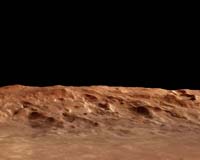
These images of the rim of the Hellas basin on Mars were obtained by the High Resolution Stereo Camera (HRSC) on board ESA's Mars Express spacecraft.
The scenes show a portion of the northern region of the Hellas basin at 29¿ S latitude and 68¿ E longitude. They were taken during orbit 488 with a resolution of 18.3 metres per pixel. North is to the right.
The Hellas basin is located in the Martian southern hemisphere, and is actually a giant impact crater.
It is about nine kilometres deep and has a rim diameter of about 2300 kilometres, which makes it one of the largest impact craters in our Solar System.
The basin floor is frost-covered in the Martian winter and appears bright even in Earth-based telescope observations.
These HRSC images show the basin rim, which is strongly dissected by elliptical and concave features, running north-west to south-east, as well as several small impact craters.
The elongated smaller basins have most likely been shaped by wind erosion ('aeolian' processes). A small valley network in the north-western part of the region suggests fluvial activity, meaning possibly action by water.
