
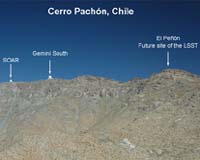
Cerro Pachon, an 8,800-foot (2,682-meter) mountain peak in northern Chile, has been selected as the site for the proposed Large Synoptic Survey Telescope. Scheduled to see first light in 2012, the 8.4-meter LSST will be able to survey the entire visible sky every three nights with its 3 billion pixel digital camera.
Its designers envision LSST probing the mysteries of dark matter and dark energy, and opening a movie-like window on objects that change or move on rapid timescales, such as exploding supernovae, potentially hazardous near-Earth asteroids as small as 100 meters, and distant Kuiper Belt objects.
The decision to place the LSST on Cerro Pachon follows a two-year campaign of in-depth testing and analysis of the atmospheric and astronomical conditions at four sites in Chile, Mexico and the Canary Islands.
The LSST site-selection committee comprised eleven members, and was chaired by Marc Sarazin of the European Southern Observatory. The committee reviewed detailed proposals from two final sites – San Pedro Mártir in Baja California, Mexico, and Cerro Pachon, regarding their suitability for the project.
The LSST corporation board of directors selected Cerro Pachon based on a recommendation from the committee.
Important factors considered for the LSST site included the number of clear nights per year, seasonal weather patterns and the quality of images as seen through the local atmosphere. The chosen site also needed to have an existing observatory infrastructure and access to fiber-optic links, to accommodate the anticipated 30 terabytes of data LSST will produce each night.
"The final decision was influenced by the existing infrastructure at Cerro Pachon and the array of synergistic facilities in the south," said Donald Sweeney, LSST's project manager.
Cerro Pachon already is home to the Gemini South 8 meter telescope and the SOAR 4.1 meter telescope. LSST will be located on a peak on Cerro Pachon named El Peñon.
In 2003, The University of Arizona Research Corporation, the National Optical Astronomy Observatory and the University of Washington formed the LSST Corporation, with headquarters in Tucson.
Since then, membership has expanded to include Brookhaven National Laboratory in New York; the Harvard-Smithsonian Center for Astrophysics in Massachusetts; Johns Hopkins University in Maryland; the Kavli Institute for Particle Astrophysics and Cosmology, and the Linear Accelerator Center, both at Stanford University; Lawrence Livermore National Laboratory in California, Las Cumbres Observatory in Mexico, the University of California, Davis; the University of Illinois at Urbana-Champaign, and Penn State University and the University of Pennsylvania.
