
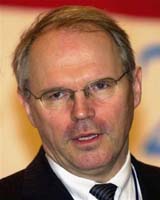
North Korea, which reneged on a nuclear deal with the United States about a decade ago, will find it difficult to break the accord forged this week to dismantle its atomic weapons program, a top US negotiator said Wednesday.
Unlike the bilateral "Agreed Framework" of 1994, which Pyongayng walked away from, the latest accord is among six countries which "North Korea has dealt face to face," Christopher Hill, the chief negotiator to the six-party talks, told the US-based National Public Radio network.
He said compared with North Korea's pledge to only freeze its nuclear weapons program under the previous pact, the latest one required it to totally abandon it, Hill said.
At the end of the fourth round of the six-party talks in Beijing on Monday, North Korea signed a "Statement of Principles" with the other five parties under which it had to give up atomic weapons in return for energy and security guarantees.
But on Tuesday the Stalinist country warned it would not dismantle its nuclear weapons until the United States delivered light-water reactors to allow it to generate power. Washington says the reactors would be discussed only after North Korea abandons its nuclear weapons in a verifiable manner.
The latest pact inked by the United States, North Korea, China, Japan, Russia, South Korea echoed the "Agreed Framework" that the Clinton Administration negotiated with the North Koreans.
Both agreements discuss a light-water nuclear reactor for Pyongyang, moves toward restoration of Washington-Pyongyang diplomatic ties, and reciprocal moves as the North dismantles its nuclear capability.
But Hill stressed that "this six party process has now produced an agreement where North Korea has dealt face to face with its neighbours and agreed to dismantle these programs."
"The North Koreans are not freezing their nuclear program but they are abandoning it," he said.
Asked whether the other five countries were capable of compelling North Korea to abide by the pact, Hill said, "Its the totality of it and by working with all these other countries, I think it is a little more difficult for North Korea to ignore us all."
On the differing interpretations between the United States and North Korea over the light-water reactor question, Hill said the North Koreans "understand full well that they can't have a discussion" on the issue "until they are back" in the Nuclear Non-Proliferation Treaty.
Under the now defunct 1994 agreement, two light-water reactors were to have been built by a US-led consortium to replace North Korea's existing graphite-moderated reactors, which can produce weapons-grade plutonium.
But the construction, which was already suffering crippling delays, was suspended after the United States in 2002 accused North Korea of developing a secret uranium enrichment program. The North responded by throwing out weapons inspectors and leaving the treaty.
Hill said inspectors would again be sent to North Korea to verify their nuclear weapons dismantlement but added that the onus was on Pyongyang to be transparent about all their nuclear activities.
"By the way, we can't go on some sort of Easter egg hunt either. It has to involve North Korean cooperation to show where the facilities are. We need their buy-in," he said.
