
North Korea may not be currently spreading nuclear weapons or nuclear weapon-construction knowledge, but Washington will not let Pyongyang "pretend" that it is in compliance, US Secretary of State Hillary Clinton told Fox News in an interview on Saturday.
"As of right now, we don't have any evidence" of active proliferation, Clinton told Fox in an interview in Baghdad.
"But we don't get satisfied by that. Because we consider North Korea to be a rogue regime that has in the past aided and abetted rogue regimes as well. And one of our highest priorities is to keep nuclear materials out of terrorist networks," Clinton said, according to an advance transcript of the interview.
"And part of the reason we are encouraged by the strong stance we got out of the United Nations, with all of the participants of the six party talks and the recent agreement on very tough sanctions on entities and goods is because we're not going to be blackmailed by the North Koreans," she said.
"We're not going to let them pretend that they are in compliance and then under the table and, you know, behind the back they are continuing to proliferate," she said.
"We're going to crack down in conjunction with the Chinese, the Russians, the Japanese, the South Koreans and other allies to try to you know tighten the band around North Korea so that they cannot do that," Clinton told Fox.
North Korea on Saturday announced that it had started reprocessing spent fuel rods to make weapons-grade plutonium, just hours after the United Nations slapped sanctions on three North Korean firms accused of backing missile development.
Pyongyang said on April 14 that it would quit six-nation nuclear disarmament talks and restart its atomic weapons program after the UN Security Council condemned Pyongyang's controversial April 5 rocket launch.
Megan Mattson, a State Department spokeswoman traveling with Clinton, earlier said that Washington continues "to seek full implementation of the September 19, 2005 Joint Statement under which North Korea committed to abandon all nuclear weapons and existing nuclear programs and return, at an early date, to the Treaty on Non-Proliferation of Nuclear Weapons and to IAEA safeguards."
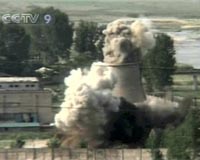
The North had been disabling parts of the Yongbyon nuclear complex as agreed under a February 2007 six-nation deal involving the two Koreas, the United States, China, Russia and Japan.
Share This Article With Planet Earth
