
North Korea on Friday launched a long-range rocket that appears to have disintegrated soon after blastoff and fallen into the ocean, South Korean and Japanese authorities said.
South Korea's defence ministry said the rocket was launched at 07:39 am (2239 GMT Thursday).
"It seems that the rocket has failed," ministry spokesman Kim Min-Seok told journalists.
"A few minutes after the launch, the rocket disintegrated into several pieces and lost its altitude," he said, adding US and South Korean officials were studying the trajectory.
North Korea has said the rocket would place a satellite in orbit for peaceful research purposes, but Western critics see the launch as a thinly veiled ballistic missile test, banned by United Nations resolutions.
North Korean officials had no immediate comment Friday on reports of the launch but said an announcement would be made before 9 am (0000 GMT).
The UN Security Council will meet in emergency session on Friday "to decide its next step" following the launch, a UN diplomat said.
German Foreign Minister Guido Westerwelle quickly condemned the launch, telling AFP it was a "violation of international obligations and will increase tensions on the Korean peninsula."
Japan's defence minister said that North Korea had launched a "flying object" that fell into the ocean after a short flight.
"We have the information some sort of flying object had been launched from North Korea" around 7:40am (2240 GMT Thursday), Defence Minister Naoki Tanaka told reporters.
"The flying object is believed to have flown for more than one minute and fallen into the ocean. This does not affect our country's territory at all."
Immediately after the launch, South Korea issued an order urging residents near the inter-Korean border to seek shelter to protect themselves from any debris that might fall from the rocket, Yonhap newswire said.
North Korea says its rocket launch is not a banned missile test and that it has every right to send the satellite up, to coincide with Sunday's centenary of the birth of its founding leader Kim Il-Sung.
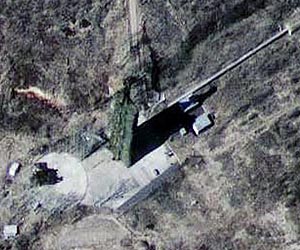
The 30-metre (100-foot) Unha-3 (Galaxy-3) rocket had been positioned at a newly built space centre on the country's northwestern Yellow Sea coast.
North Korea has invited up to 200 foreign journalists to Pyongyang for the launch and the weekend commemorations, the largest number of overseas media ever welcomed in to the reclusive state.
The reclusive nation is in the midst of cementing a power transition between late leader Kim Jong-Il who died last December and his untested son Kim Jong-Un who is aged in his late 20s.
US Secretary of State Hillary Clinton had earlier warned North Korea of UN Security Council action if it pressed ahead with the launch.
"If Pyongyang goes forward (with the launch) we will all be back in the Security Council to take further action," Clinton told reporters after consulting with her counterparts from the Group of Eight industrial nations.
"There is no doubt that this (launch) would use ballistic missile technology," she said, urging Pyongyang to refrain from "pursuing a cycle of provocation".
Her comments were followed by an unusually strongly worded statement issued by foreign ministers of the Group of Eight which "demanded" that North Korea abandon the launch.
Russia's envoy to the United Nations, Vitaly Churkin, has said that all Security Council members agreed that a launch would be a "violation" of UN sanctions resolutions imposed in 2009 after Pyongyang's last nuclear test.
Chronology of North Korean missile development
Seoul (AFP) April 13, 2012 –
North Korea on Friday launched a long-range rocket that appeared to have disintegrated soon after blastoff, according to South Korean authorities. North Korea has said the rocket was aimed at putting a satellite in orbit, but Western critics see the launch as a thinly veiled ballistic missile test, banned by UN resolutions.
These are key dates in the communist country's missile programme:
Late 1970s: Starts working on a version of the Soviet Scud-B (range 300 km or 187 miles). Test-fired in 1984
1987-92: Begins developing variant of Scud-C (500 km), Rodong-1 (1,300 km), Taepodong-1 (2,500 km), Musudan-1 (3,000 km) and Taepodong-2 (6,700 km)
Aug 1998: Test-fires Taepodong-1 over Japan as part of failed satellite launch
Sept 1999: Declares moratorium on long-range missile tests amid improving ties with US
July 12, 2000: Fifth round of US-North Korean missile talks ends in Kuala Lumpur without agreement after North demands one billion dollars a year in return for halting missile exports
Dec 2002: Fifteen North Korean-made Scuds seized on Yemen-bound ship
March 3, 2005: North ends moratorium on long-range missile testing, blames Bush administration's "hostile" policy
July 5, 2006: North test-fires seven missiles, including a long-range Taepodong-2 which explodes after 40 seconds
July 15, 2006: UN Security Council adopts Resolution 1695, demanding halt to all ballistic missile activity and banning trade in missile-related items with the North
Oct 9, 2006: North conducts underground nuclear test, its first
Oct 14, 2006: Security Council approves Resolution 1718, demanding a halt to missile and nuclear tests. Bans the supply of items related to the programmes and of other weapons
April 5, 2009: North Korea launches long-range rocket which flies over Japan and lands in the Pacific, in what it says is an attempt to put a satellite into orbit. The United States, Japan and South Korea see it as a disguised test of a Taepodong-2
April 13, 2009: UN Security Council unanimously condemns launch, agrees to tighten existing sanctions. North quits nuclear disarmament talks in protest and vows to restart its plutonium programme
May 25, 2009: North conducts its second underground nuclear test, several times more powerful than the first
June 12, 2009: Security Council passes Resolution 1874, imposing tougher sanctions on the North's atomic and ballistic missile programmes
July 4, 2009: North test-fires seven ballistic missiles off its east coast
Feb 18, 2011: Satellite images show the North has completed a launch tower at its new west coast missile base at Tongchang-ri, experts say
May 15, 2011: North Korea and Iran are suspected of sharing ballistic missile technology, according to a UN sanctions report, diplomats say
March 16, 2012: North Korea announces it will launch a long-range rocket between April 12-16 to put a satellite into orbit
April 13, 2012: Rocket is launched from the Tongchang-ri base and appears to have disintegrated soon after blastoff and fallen into the ocean, South Korean authorities said.
