
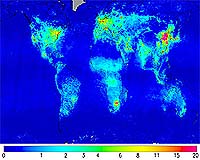
A large amount of the greenhouse gas nitrous oxide is produced by bacteria in the oxygen poor parts of the ocean using nitrites, Dr Mark Trimmer told journalists at a Science Media Centre press briefing. Dr Trimmer looked at nitrous oxide production in the Arabian Sea, which accounts for up to 18% of global ocean emissions. He found that the gas is primarily produced by bacteria trying to make nitrogen gas.
"A third of the 'denitrification' that happens in the world's oceans occurs in the Arabian Sea (an area equivalent to France and Germany combined)" said Dr Trimmer from Queen Mary, University of London. "Oxygen levels decrease as you go deeper into the sea. At around 130 metres there is what we call an oxygen minimum zone where oxygen is low or non-existent. Bacteria that produce nitrous oxide do well at this depth."
Gas produced at this depth could escape to the atmosphere. Nitrous oxide is a powerful greenhouse gas some 300 times more so than carbon dioxide, it also attacks the ozone layer and causes acid rain.
"Recent reports suggest increased export of organic material from the surface layers of the ocean under increased atmospheric carbon dioxide levels. This could cause an expansion of the oxygen minimum zones of the world triggering ever greater emissions of nitrous oxide."
earlier related report
Greenhouse gas from English streams
English chalk streams are less healthy than we thought and are potentially even contributing to global warming, said Dr Mark Trimmer at a Science Media Centre press briefing today.
Dr Trimmer looked at a plant that covers up to three quarters of the surface of some streams and found that it helps methane generated in the sediment beneath the plants to escape into the atmosphere. "We found similar emissions to some UK peat bogs" said Dr Trimmer from Queen Mary, University of London. "This changes our perception of the health of the ecosystem and it indicates another disadvantage of agriculture."
Over 90% of the methane emissions from the river Frome in Dorset that reach the atmosphere do so via the stems of water crowfoot. The plant also causes a build-up of sediment from neighbouring farmland, which aids the production of methane by bacteria in the stream.
"Chalk streams are a British specialty habitat and a priority under the UK's Biodiversity Action Plan. They have a high status but there is growing concern about their ecological decline."
Dr Trimmer estimates that the total area of chalk streams in the UK is around 20 km2. The situation he observed in Dorset is likely to be widespread. More research is needed to understand methane emissions from chalk streams fully. "There is obvious climatic concern for any unquantified potential source of methane."
