
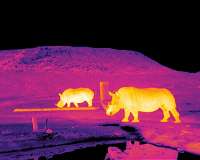
A ninth critically endangered black rhino has been reported dead after a botched operation to move the animals to a new reserve in southern Kenya, the country's tourism minister said on Tuesday.
Eight rhinos were initially reported by officials to have died following last month's attempt to transfer 11 of the animals from Nairobi and Lake Nakuru national parks to Tsavo East.
Police detectives have now been brought in and given one week to determine what caused the deaths, said Tourism Minister Najib Balala at a briefing in Nairobi.
"Nine of them died due to reasons we are still investigating. The preliminary report that we got from the experts from Kenya Wildlife Service was saying it's the saline water" they drank, he added.
The minister confirmed that he had seen the 18 horns that belonged to the dead animals and that none had gone missing following the fatalities.
"The beauty is that all these horns have transmitters and electronic chips," he said.
Save the Rhinos estimates there are fewer than 5,500 black rhinos in the world, all of them in Africa, while Kenya's black rhino population stands at 750, according to the Worldwide Fund for Nature.
Between 2005 and 2017, 147 black rhinos were transferred to new habitats in Kenya, the tourism ministry said. Just eight died following those transfer operations.
According to KWS figures, nine rhinos were killed in Kenya last year.
In May, three more were shot dead inside a specially-protected sanctuary in northern Kenya and their horns removed, while in March the last male northern white rhino on earth, an elderly bull named Sudan, was put down by Kenyan vets after falling ill.
Rhinos have few natural predators because of their size and thick skin but are targeted by poachers for their horns which are highly valued in parts of Asia where they are believed to have medicinal qualities.
Huge demand from China and Vietnam where the horns can fetch tens of thousands of dollars has led to a collapse in the number of rhinos in the wild.
China seizes 156 mammoth tusks in huge ivory haul
Beijing (AFP) July 19, 2018 –
Chinese customs authorities said they seized 156 prehistoric mammoth tusks from a truck entering from Russia in one of the country's largest such hauls.
The contraband was seized in late April at a border crossing in northeastern China's Heilongjiang province bordering on Siberia, but the find was only announced this week by Chinese customs, state media said.
The haul, which also included two elephant tusks and a range of other animal parts, was hidden under a shipment of soybeans.
Eight suspects, including Russians and Chinese, have been arrested, the People's Daily said.
China banned the sale and processing of elephant ivory last year after having banned its import in 2015.
This, along with global efforts to stamp out the ivory trade to save elephants from extinction, have led smugglers to turn to a stock of ancient mammoth tusks buried mostly in Siberia but also Europe and North America.
The People's Daily said the shipment as a whole was one of China's largest involving animal parts in recent years.
The official Xinhua news agency said the inventory included "two elephant tusks, 1,276 antelope horns, 156 mammoth tusks, 406 walrus tusks, 226 narwhal tusks, as well as gall bladders and bear teeth and 320 kilos of sea cucumbers."
A wide variety of animal parts are sought after in China as traditional medicines or for other uses, while ivory carving is an ancient art in the country.
The latest seizure's estimated value was 106 million yuan ($15.7 million), Xinhua said, adding that an investigation was under way.
Just 84 Amur leopards remain in the wild, study finds
Washington (UPI) Jul 13, 2018 –
Scientists estimate there are only 84 Amur leopards left in the wild in China and Russia. The leopards live along the southernmost border of the Primorskii Province in Russia and the Jilin Province of China, and they're highly endangered.
This new estimate was recently reported in the scientific journal Conservation Letters by scientists from China, Russia and the United States. The scientists teamed up to gather information from camera traps on both sides of the border.
There are no records of the leopards in other parts of its former range, so this estimate along the border represents the total global population of the subspecies in the wild, researchers say.
The camera traps allow scientists to identify each leopard by its unique spot pattern, providing a precise estimate. About one-third of the leopards were photographed on both sides of the Sino-Russian border.
"We knew that leopards moved across the border, but only by combining data were we able to understand how much movement there really is," said Anya Vitkalova, a biologist at Land of the Leopard National Park in Russia who led the study.
The leopards appear to be recolonizing habitat in China from the Russian side, where there are many more of them, the researchers found.
The new study is the first estimate of the global population of the Amur leopard, and proves the value of international collaboration, according to Dale Miquelle, a co-author and Tiger Program Coordinator for the Wildlife Conservation Society.
"The trust and goodwill generated by this joint effort lays the foundation for future transboundary conservation actions," Miquelle said.
