
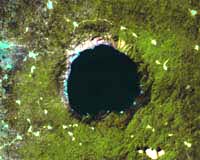
Meteorite craters are a rare find on Earth, numbering only 175 at last count, but a Canadian researcher unveiled Tuesday a new computer tool for locating hundreds more from even the tiniest of clues.
According to observations of the Moon and Mars, a small meteorite is predicted to impact Earth every 10 years. Mars Orbiter Camera has shown, for example, that at least 20 such impacts formed on the red planet since 1999.
But of the 175 known craters on Earth, only five are less than 100 meters in diameter, and fewer than 10 are less than 10,000 years old.
"Small impact events recorded on the surface of the Earth are significantly underrepresented based on expected magnitude-frequency relations," said Chris Herd, an assistant professor at the University of Alberta's earth and atmospheric sciences department, in an abstract of his research.
Herd applied a new computer program to filter out trees and foliage from an aerial survey of a small crater discovered in 2007 near the town of Whitecourt, about 200 kilometres (124 miles) west of Edmonton, Alberta.
The aerial images taken by a forestry company using 3D mapping technology, once stripped of trees, revealed a bowl-shaped crater 36 meters in diameter and 1,100 years old — recognized as the youngest crater in Canada.
"This technology can be used to potentially reveal hundreds of meteorite craters around the world that are hidden by trees but unknowingly captured on aerial forest surveys," Herd said.
Also, "as more craters are found and analyzed, existing theories on how many meteorites have hit Earth in the past and the frequency of future impacts will change," he said.
His research was published Tuesday in the journal Geology.
Share This Article With Planet Earth
