
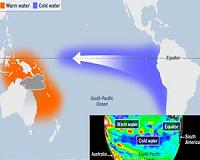
Two new studies from The University of Texas at Austin have significantly improved scientists' ability to predict the strength and duration of droughts caused by La Nina – a recurrent cooling pattern in the tropical Pacific Ocean. Their findings, which predict that the current La Nina is likely to stretch into a second year, could help scientists know years in advance how a particular La Nina event is expected to evolve.
"Some La Nina events last two years, and predicting them is extremely challenging," said Pedro DiNezio, a research associate at the University of Texas Institute for Geophysics (UTIG).
The studies were published in November in the journal Geophysical Research Letters. DiNezio and UTIG Research Associate Yuko Okumura were authors on both studies and collaborated with scientists from the National Center for Atmospheric Research (NCAR). UTIG is a research unit of the UT Jackson School of Geosciences.
The southern United States, including parts of eastern Texas, regularly experiences warm and dry winters caused by La Nina. Therefore, predicting La Nina's evolution, particularly its duration, is key.
The first study, led by Okumura, showed that La Nina's impact on atmospheric circulation and southern U.S. drought becomes stronger in the second year. This is despite a weakening of La Nina's cooling over the tropical Pacific relative to the first year.
"We expected a weaker impact in the second year, but it turned out to be the opposite," said Okumura. "Despite being weaker in the second year, La Nina appears to have a greater impact."
Okumura found that this paradox is caused by subtle changes in the pattern of tropical Pacific cooling. During the second year, the cooling weakens in a narrow band along the equator, but becomes broader. The broader cooling appears more effective at influencing the atmosphere far away from the tropical Pacific, according to analysis of historical observations.
"Predicting if La Nina will last multiple years is therefore essential to knowing how long the drought will last," Okumura said.
The second study, led by DiNezio, used a climate model developed at NCAR to predict that an ongoing La Nina that started in 2016 will stretch into its second year this upcoming winter. The model puts the probability of such an event occurring at 60 to 80 percent.
DiNezio and Okumura had previously found that a La Nina is more likely to last two years when it is preceded by a strong El Nino – its warm counterpart. Therefore, when a record-breaking El Nino event occurred just two years ago, they anticipated that it could lead to a two-year La Nina. DiNezio used the model developed at NCAR to test this idea.
To back their predictions, they tested whether the model could have predicted previous two-year La Nina events that occurred after strong El Ninos. They were particularly confident in the model when they saw that it predicted the three-year La Nina following the 1997 El Nino, a record-breaking event at the time.
So far, it looks like the NCAR model's prediction is on the money. The National Oceanic and Atmospheric Administration (NOAA) announced last week that ocean conditions in the tropical Pacific are starting to show signs that La Nina is on its way for a second year.
DiNezio and Okumura will be keeping a close eye on this year's La Nina as they seek to better predict its impacts throughout the world.
Tiny Fiji looks for global impact at Bonn climate talks
Fiji's Prime Minister Frank Bainimarama brings a sobering message as he presides over UN climate talks in Bonn this week – climate change is real, it's already having disastrous impacts on his people and only urgent action can address the problem.
Germany is hosting the talks and asked Bainimarama to act as president to highlight how the issue is affecting Pacific island nations on the fron … read more
