
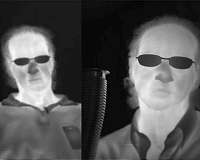
Testing tools and technologies for refueling and repairing satellites in orbit won't be the only demonstration taking place aboard the International Space Station during NASA's next Robotic Refueling Mission 3, or RRM3.
Like its QWIP predecessor, SLS is a large-format detector. The arrays are fabricated on a semiconductor wafer. The wafer's surface consists of hundreds of alternating, very thin layers of differing materials that are epitaxially grown and tuned to absorb infrared photons and convert them into electrons – the fundamental particles that carry an electric current.
Only light with a specific energy, or wavelength, can release the electrons. A read-out chip directly mated to the array then converts the electrons to a voltage that a computer uses to recreate an image of the infrared source. The CTI can also capture video from its orbit nearly 249 miles above Earth's surface.
Ten Times More Sensitive
Compared with its QWIP predecessor, SLS detectors are 10 times more sensitive and operate over a broader infrared spectral range and at substantially warmer temperatures – 70K (about -334 degrees Fahrenheit) for the SLS array compared with 42K (about -384 degrees Fahrenheit) for the QWIP array.
The increase in operating temperature will have multiple positive effects on future missions, Jhabvala said.
Infrared radiation is sensed as heat. Therefore, detectors designed to measure infrared wavelengths must be cooled to prevent heat generated inside an instrument or spacecraft from contaminating the measurements of the object being observed.
That's why engineers use cryocoolers and other devices to keep the detector arrays and other critical instrument components as cold as necessary.
Because Jhabvala and his team have created an array that can operate at warmer temperatures, its cooling system is smaller and consumes less power. In the future, these attributes will lead to smaller satellites, increased longevity, shorter build cycles, and a lower cost, Jhabvala said.
Just a few months before the RRM3 launch, Jhabvala reflected on the evolution of his photodetector technology and collaboration with QmagiQ, which has received NASA Small Business Innovation Research grants to create the technology that the CTI team then ruggedized for use in space.
"Together, with this company, we have made some outstanding achievements over the years," Jhabvala said. "Our on-going collaboration has yielded some truly extraordinary returns for NASA and the U.S. government. I give QmagiQ and NASA a lot of credit."
