
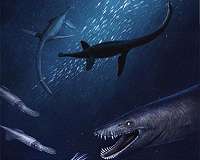
A team of German and Swedish scientists have identified a new long-necked marine reptile species of the early Jurassic.
The 190 million-year-old bones were first discovered in the early 1990s, but only recently identified. The species was an relative of pliosaurids, a group of super predator plesiosaurs that dominated the oceans during the Jurassic period.
"Plesiosaurs were amongst the most successful marine predators from the age of dinosaurs," Sven Sachs, a researcher at the Naturkunde-Museum Bielefeld in Germany, said in a news release. "Some, such as the famous Liopleurodon, were colossal predators up to 15 meters long. They were the equivalent of white sharks and killer whales in the oceans today."
Sachs and his colleagues named the new species Arminisaurus schuberti after Arminius, a chieftain who led a group of Germanic tribes to victory over the Roman legions at the Battle of the Teutoburg Forest in 9 A.D.
Compared to its relatives, Arminisaurus is relatively small, measuring 3 to 4 meters, or 10 to 13 feet.
Mining machinery crushed many of the specimen's bones, but enough of the fossil remains were left intact — including the skull, vertebrae and limb bones — for Arminisaurus to be identified as a unique species.
"Arminisaurus is significant because it dates from a timeframe early in the Jurassic, during which we have very few identifiable plesiosaur fossils," said Benjamin Kear, curator of vertebrate palaeontology at the Museum of Evolution at Uppsala University in Sweden. "Only two other plesiosaur fossils have ever been named from this mysterious interval in plesiosaurian evolution, making Arminisaurus a very important new addition for the global record of the group."
Though smaller than its later relative, researchers were able to identify several anatomical parallels between Arminisaurus and pliosaurids.
Researchers detailed their discovery in a new paper published this week in Alcheringa.
Volcanic carbon dioxide drove ancient global warming event
New research, led by the University of Southampton and involving a team of international scientists, suggests that an extreme global warming event 56 million years ago was driven by massive CO2 emissions from volcanoes, during the formation of the North Atlantic Ocean.
The study, published in Nature, used a combination of new geochemical measurements and novel global climate modelling to s … read more
