
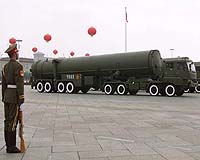
The Pentagon's latest assessment of China's military power said Beijing would deploy a new mobile nuclear missile, the DF-31, in 2005-2006 and the new missile was capable of hitting Australia in an arc from Brisbane to Perth, the Herald Sun newspaper reported Sunday.
In 2007-2009, China is planning to deploy a new intercontinental ballistic missile, the DF-31A, which has a far greater range and would be able to strike any Australian city, New Zealand and most of the United States, the report said.
At present, China's strategic nuclear weapons have been based in silos. They are liquid-fueled, making them easier targets for satellites to pick up and to strike. But the new and mobile DF-31s are solid-fueled, have a longer range and are much harder to detect.
The report said: "China is qualitatively and quantitatively improving its strategic missile force. This could provide a credible, survivable nuclear deterrent and counter-strike capability."
Hugh White, one of Australia's leading defense analysts, told the Sun Herald newspaper that China's deployment of solid-fuel missiles was a "very significant" step. Liquid-fuel missiles took time to fuel and were detectable by satellites. But solid-fuel missiles could be hidden and moved around to avoid being destroyed, he said.
"The U.S. would now be concerned that China's nuclear arsenal was more survivable from attack. And that fear could fuel a missile build-up on both sides," White said. "You could get a return to the logic of strategic competition which existed during the Cold War."
