
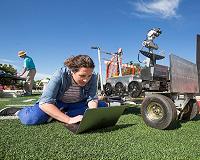
Six minutes of air, 14 obstacles and five mission tasks lay ahead of the intrepid explorers. Decisions on which obstacles and tasks to complete and which to bypass must be made by them and their teammates, knowing that at the end of six minutes, only a one-minute reserve of oxygen is left to get them to their home base. If they do not return home before the end of the seventh minute, all will be lost.
The mission is not for the faint-hearted, nor will it be taking place on another world or with actual oxygen limitations. Instead, it is the newly designed NASA Human Exploration Rover Challenge competition held at the U.S. Space and Rocket Center in Huntsville, Alabama, in April 2018.
The annual competition challenges high school and college students from around the United States and the globe to design, build, test and compete on human-powered rovers across a bruising 3/4-mile course. Registration for the competition is open.
Once focused primarily on finishing the course in the fastest time, the new format sets teams up to think more like mission planners and explorers during the competition than ever before.
"What was once a race is now an excursion with realistic exploration elements," said Frank Six, university affairs officer and founder of the competition at NASA's Marshall Space Flight Center in Huntsville. "Those rover teams with the best technologies and best strategies of attempting tasks and obstacles will be the winners."
Participating teams will have a map and description of the obstacles and tasks, allowing them to plan in advance which to attempt and which to bypass. Teams will be given points based on how well they perform the attempted tasks and navigated obstacles. If a bypass is used, no points will be awarded for the bypassed task or obstacle. While no longer a race, if a team fails to return to the finish line before the allotted time expires – when their virtual oxygen has been consumed – all points gained on the course are forfeited. Each team will be granted two attempts at the course; their highest score will count.
The tasks in this year's competition are:
1. Solid Soil Sample Retrieval – Collect, bag and store solid surface samples
2. Spectrographic Analysis – Take photographs with a camera using different filters
3. Instrument Deployment – Deploy a solar powered cell for a scientific instrument
4. Flag Plant and Photo – Successfully plant a flag and take a photograph
5. Liquid Sample Retrieval – Collect, bag and store three separate liquid samples
Information about the fourteen obstacles can be found on the challenge's website.
Onboard displays – in the form of the drivers' cell phones or written checklists – are allowed for the excursions. Drivers – also known as rovernauts – may communicate with their teams using radios during their excursions for strategy and updates.
In addition to communication, strategy and completing tasks and obstacles, teams must also be diligent and deliberate in developing their rovers. As in past years, wheels – with the exception of the central hub – must be developed by the teams and not purchased commercially off the shelf.
Creation of innovative drivetrains – the system that transfers the drivers' input energy to the wheels – provide teams an opportunity to win a separate award. Traditional drivetrains of chains and sprockets are unlikely to be used on planetary surfaces due to their susceptibility to damage from the foreign environments. Newly designed drivetrains in the 2017 competition included a ratchet system and a belt drive system.
As in past years, the rover – in its stowed configuration – must fit into a cube measuring 5 feet on each side, and points will be awarded based on time to unstow and configure the rover for use.
As NASA and the space industry continue to innovate and set their eyes on exploring the many planetary bodies of the solar system – including the Moon and Mars – it is vital that the next generation of engineers, scientists, explorers and team members are encouraged and mentored to do the same. Entering its 24th year of competition, the Human Exploration Rover Challenge continues to be a flagship competition and education opportunity for NASA.
Registration for the competition is open until Dec. 15 for international teams and Jan. 19 for U.S. teams. To register or to learn more, visit here
Cars and speakers: Baidu speeds up AI progress
Chinese web giant Baidu unveiled Thursday a smart speaker model and plans for a self-driving mini-bus, its latest foray into the hyper-competitive field of artificial intelligence.
Baidu will collaborate with bus manufacturer King Long to develop and produce the first model of a fully autonomous mini-bus, Baidu CEO Robin Li said during the company's annual technology conference at a glitzy B … read more
