
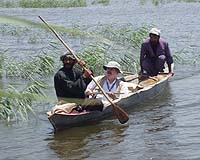
A restoration project has revived nearly half Iraq's marshlands, which were drained by Saddam Hussein to punish the country's restive Shiite Muslim majority, the United Nations said Thursday.
The project, which is funded by the Japanese and Italian governments, is aimed at restoring the traditions of the swampy southern region, which may have been the the Bible's Garden of Eden.
The UN Environment Program, which manages the project, announced in Tokyo that satellite data showed close to 50 percent of the marshlands had been restored.
"Improving the environment and improving the livelihoods of the people living there can only be a positive development in helping to bring about peace and security at least in that part of Iraq," said Robert Bisset, the UN agency's press officer.
An estimated 100,000 people have returned to the marshlands, which at their height were home to half a million people. The project has brought safe drinking water to some 22,000 people, according to the UN agency.
Most marsh residents are Shiite Muslims, who form the majority in Iraq but were marginalized until the US-led invasion overthrew Saddam in 2003.
Shiites were crushed when they rebelled against Saddam in 1991 following the first Gulf War. Saddam drained the marshland, which in the 1970s had stretched for some 20,000 square kilometers (7,700 square miles).
The multimillion-dollar restoration project has set up some 23 kilometers (14 miles) of pipes to distribute water to the area, the UN Environment Program said.
It has also trained 300 Iraqis on how to manage the marshland, it said.
The second phase of the project will include further technical training and analysis of socioeconomic factors to restore the marshlands more fully.
"We would like to do more activities on the ground," Bisset said, "to provide a better environment to help more people come back to their region."
Source: Agence France-Presse
