
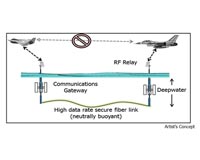
The Navy announced Monday it is developing technology for the wireless underwater recharging of unmanned undersea vehicles at the Space and Naval Warfare Systems Center Pacific.
Current UUVs used for reconnaissance, mine hunting, and other tasks need to be recharged manually at either port or ship. Underwater charging stations would allow the craft to stay on station for much longer periods of time.
"Unmanned and autonomous systems are used extensively for Navy missions and will continue to play a large role in future Navy and joint scenarios," advanced integrated circuit technology chief chief Dr. Alex Phipps said in a press release.
"While most of these systems are able to perform their mission without human interaction, limitations in the amount of power that can be stored place a limit on the overall system autonomy."
The technology is similar to wireless charging pads currently available for smartphones and other devices. The proof-of-concept for the Navy's underwater version was demonstrated with a cellphone in a plastic bag underwater. The technology has since been advanced significantly.
"This type of technology is going to widen the array of missions the Navy can use UUVs for," SPAWAR project engineer Dr. Graham said.
"Having a UUV that can travel long distances gathering intel from ports and areas of the world our surface ships and underwater craft typically can't go is going to increase the effectiveness of them."
"It's a safer, more cost-effective option that we're really excited about."
Sediment research is a granular exercise at NRL
It's an unseasonably warm February afternoon at the U.S. Naval Research Laboratory, Stennis Space Center (SSC), Mississippi, where three men are tinkering with a 7-foot tall, four-legged instrument platform, preparing it for an upcoming research experiment off the coast of Virginia.
The rugged apparatus known as a "quadpod," was built to withstand being on the bottom of the ocean for weeks … read more
