
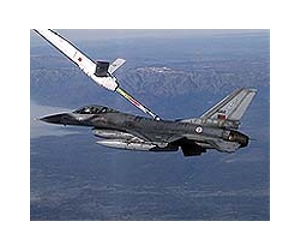
After hanging over the blue Mediterranean for a couple of hours, Canadian tanker pilot Steve Aston welcomed his first customers — a pair of thirsty British combat jets.
His Canadian refueller, a modified civilian Airbus turned tanker, then deployed 24-meter (80-foot) hoses from each wing to deliver thousands of liters (pounds) of fuel enabling the Tornado and Typhoon jets to return to combat over Libya.
Deploying probes from their noses to connect with the hose some 7,600 meters (25,000 feet) above the sea, the aircraft cruised at 300 knots (555 kilometers per hour) before separating less than 10 minutes later.
This routine yet vital task is what allows NATO to keep sending steady streams of fighters into Libya to maintain pressure on Moamer Kadhafi, whose military has been left in tatters but remains in power despite daily bombings.
Canada's two Airbus tankers and some 35 refuelling aircraft from seven other nations provide 1.1 million liters of fuel per day to surveillance planes and combat jets, which burn massive amounts of fuel roaring south from bases across the Mediterranean on their way to Libya.
"It's an essential part of getting the mission done," said Major Aston, a 47-year-old pilot who migrated to Trenton, Ontario, and became Canadian after 22 years on the British Royal Air Force.
"All of our fighter and reconnaissance assets are based in the northern Mediterranean, and being able to refuel them as they come down to the area of interest means they can stay on station for a good length of time to carry out their missions," he said.
"Without the refuelling, it would not be possible to carry out this mission."
The Canadian tanker had a crew of four: Aston, a co-pilot, a refuelling technician who operates the hose and communicates with the jets, and a load master who fills up the plane's huge tank.
NATO was short of refuelling planes after it took command of the operation from a coalition led by the United States, France and Britain on March 31.
The alliance filled the gap weeks later after the United States provided nine more tankers and Italy came forward with two, a NATO official said on condition of anonymity.
The United States provides the bulk of the tankers with 25, while France contributes three. Britain, Spain, Italy and Canada provide two each, while Turkey contributes one. Non-NATO partner Sweden also deployed one tanker.
"We are in a much better position now," the alliance official said.
During a six-hour flight, the Canadian tanker delivered some 130,000 pounds of fuel, or 20,000 pounds per aircraft. After the British jets, two Italian Tornados came to be refuelled.
When the RAF jets came back later for more fuel, the Typhoon had one less precision-guided bomb than in the first refuelling run — presumably, he had deployed it somewhere in Libya.
A final plane, another British two-seater Tornado, was the last customer of the day, topping up with 10,000 pounds of fuel before easing off the hose and turning sideways far off into the horizon within seconds.
