
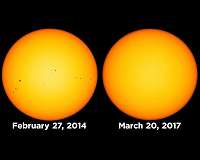
For 15 days starting on March 7, 2017, NASA's Solar Dynamics Observatory, or SDO, returned visible light images of a yolk-like spotless sun.
This is the longest stretch of spotlessness since the last solar minimum in April 2010, indicating the solar cycle is marching on toward the next minimum, which scientists predict will occur between 2019-2020.
The sun goes through a natural 11-year cycle marked by two extremes: solar maximum and solar minimum. Sunspots are dark regions of complex magnetic activity on the sun's surface, so the number of sunspots at any given time is used as an index for solar activity.
Solar maximum is characterized by intense solar activity and the greatest sunspot number.
Conversely, during solar minimum, the sun is least active and sunspot number is at its lowest.
Solar activity, however, does not end as sunspot number decreases toward minimum.
There are other sources of solar activity such as high-speed streams of solar material from coronal holes, which spark aurora and other space weather effects.
The SDO images here compare the sun on March 20, 2017, and February 27, 2014, during the last solar maximum when the sun sported numerous spots.
Cornell's FOTON studies 'space weather' to improve satellite communication
Cornell University engineers have developed a new piece of technology to study charged particles in the plasma of space, on the edge of Earth's atmosphere – known as "space weather." These particles affect the performance of communications and navigation satellites.
To study conditions in the ionosphere, a band between 50 and 600 miles above the Earth, Steven Powell and others in Cornell's … read more
