
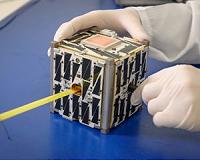
Beginning in October 2013, the NASA Science Mission Directorate, or SMD, started a new CubeSat Initiative — a cross divisional project to develop scientific CubeSats for all four science divisions within SMD.
CubeSats offer a low-cost option for enabling scientific discovery related to astrophysics, heliophysics, Earth and planetary sciences, addressing space technology and exploration systems development needs, and extending important hands-on experience to undergraduate and graduate students.
Through effective internal and external partnerships, combined with existing SMD suborbital investments, NASA leverages CubeSats for exploratory and potentially systematic science observations at minimal cost.
With missions that can be less than $2 million to $4 million per satellite and with a rapid development cycle, along with the advent of routine access to space provided by NASA and the U.S. Department of Defense launch vehicles, and evolving nanosat launch systems, CubeSats are now a viable frequent flight opportunity for rapid innovation in science and technology.
SMD CubeSats are offered as part of the annual ROSES — for Research Opportunities in Space and Earth Sciences — solicitation. For the 2014 fiscal year, six new CubeSat missions were selected:
+ Helio-1 "ELFIN-STAR" – Principal Investigator: V. Angelopoulos, UCLA
ELFIN-STAR seeks to understand storm-time precipitation of radiation belt relativistic electrons and determine if electromagnetic ion cyclotron waves are responsible for the precipitation.
+ Helio-2 "CuSPP" – Principal Investigator: M. Desai, Southwest Research Institute
CuSPP will study solar particles over Earth's poles to provide space weather relevant observations through combined interplanetary energetic particle and suprathermal source population observations at high cadence.
+ Helio-3 "TBEx" – Principal Investigator: R. Tsunoda, SRI, NASA's Goddard Space Flight Center
TBEx will significantly improve the understanding of the role of atmospheric gravity waves on the formation of equatorial plasma bubbles.
+ Helio-4 "MinXSS" – Principal Investigator: T. Woods, LASP, NASA's Goddard Space Flight Center
MinXSS will improve understanding of solar spectral irradiance to improve modeling capabilities and reduce uncertainty regarding where in the upper atmosphere of Earth solar photon energy is deposited.
+ Helio-5 "SORTIE" – Principal Investigator: G. Crowley, Atmospheric and Space Technology Research Associates
SORTIE will investigate the underlying causes behind the appearance of plasma structures in the F-region of Earth's ionosphere, leading to equatorial plasma bubbles, and the evolution of these structures after formation.
+ Earth-1 "IceCube" – Principal Investigator: D. Wu, NASA's Goddard Space Flight Center
IceCube is a sub-millimeter wave radiometer to advance understanding of ice clouds and their roles in climate change.
