
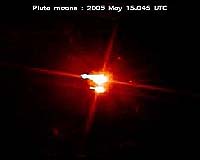
Pluto, the smallest and most distant planet of the solar system, may have three moons instead of just one, according to images NASA said were taken by the orbiting Hubble Space Telescope.
Astronomers from the Southwest Research Institute reported observing the moons in May as they described near circular orbits around the icy planet in three days, the National Aeronautics and Space Administration said.
If the discovery is confirmed by the International Astronomical Union, the two new moons will be named after characters in Greek and Roman mythology and take their side along Charon, Pluto's moon discovered in 1978.
For the time being, the two tiny satellites have been named S/2005 P1 and S/2005 P2. They have eluded detection so long because they are 5,000 times dimmer than Pluto.
The two moons-in-waiting were observed to be approximately 44,000 kilometers (27,000 miles) and 53,000 kilometers (44,000 miles) away from Pluto — two or three times as far from the planet as Charon.
Compared to Charon's 1,200 kilometer (745 mile) diameter, the two new moons are pint-sized: just 32 kilometers (20 miles) and 70 kilometers (43 miles) across, respectively.
Pluto was discovered in 1930 at a distance of some 6.4 billion kilometers (three billion miles) from the sun in the heart of the Kuiper Belt — a zone beyond Neptune 4.5-7.5 billion kilometers (2.8-4.6 billion miles) from the sun.
The Kuiper Belt is estimated to include more than 35,000 objects of more than 100 kilomters (65 miles) in diameter: the remnants of the sun's accretion ring of matter from which all the planets were formed.
"If, as our new Hubble images indicate, Pluto has not one, but two or three moons, it will become the first body in the Kuiper Belt known to have more than one satellite," said astrophysicist Hal Weaver, of the Johns Hopkins Applied Physics Laboratory, in Laurel, Maryland, and a co-leader of the team that made the discovery.
The discoveries were made as the team prepared a NASA robotic mission to Pluto and the Kuiper Belt to be launched early next year.
Pluto, with its relatively small diameter of 2,252 kilometers (1,400 miles) is not considered a real planet by many astronomers.
