
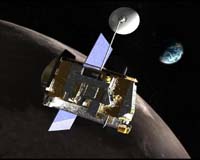
NASA announced Thursday that its Lunar Reconnaissance Orbiter has completed its mission confirmation review and is ready to proceed to its implementation phase.
The review represents NASA's formal decision to authorize additional work on the spacecraft and sets the project's estimated cost. Agency officials determined that the mission remains within budget projections and is on schedule to launch in October 2008.
The LRO would be NASA's first major lunar mission in 36 years, following the Apollo 17 landing in December 1972. It represents a key step forward in the agency's two-year-old Vision for Space Exploration, a keystone of which is returning humans to the Moon.
The spacecraft will spend a year mapping the lunar surface from an average altitude of about 30 miles. It will carry six instruments and one technology demonstration specifically designed for preparing future human exploration efforts.
NASA's Goddard Space Flight Center will build the orbiter, which will contain instruments provided by several organizations in the United States and one in Russia. The instruments will generate a complete surface map of the moon, intended to help mission planners determine potential landing sites.
The spacecraft also will measure sunlight and temperature patterns at the Moon's poles, search for potential resources such as water, and assess the deep-space radiation environment and its potential effects on humans.
The LRO's next milestone will be the critical design review, scheduled for later this year, which includes completion of detailed system designs and marks the transition into manufacturing and assembly.
